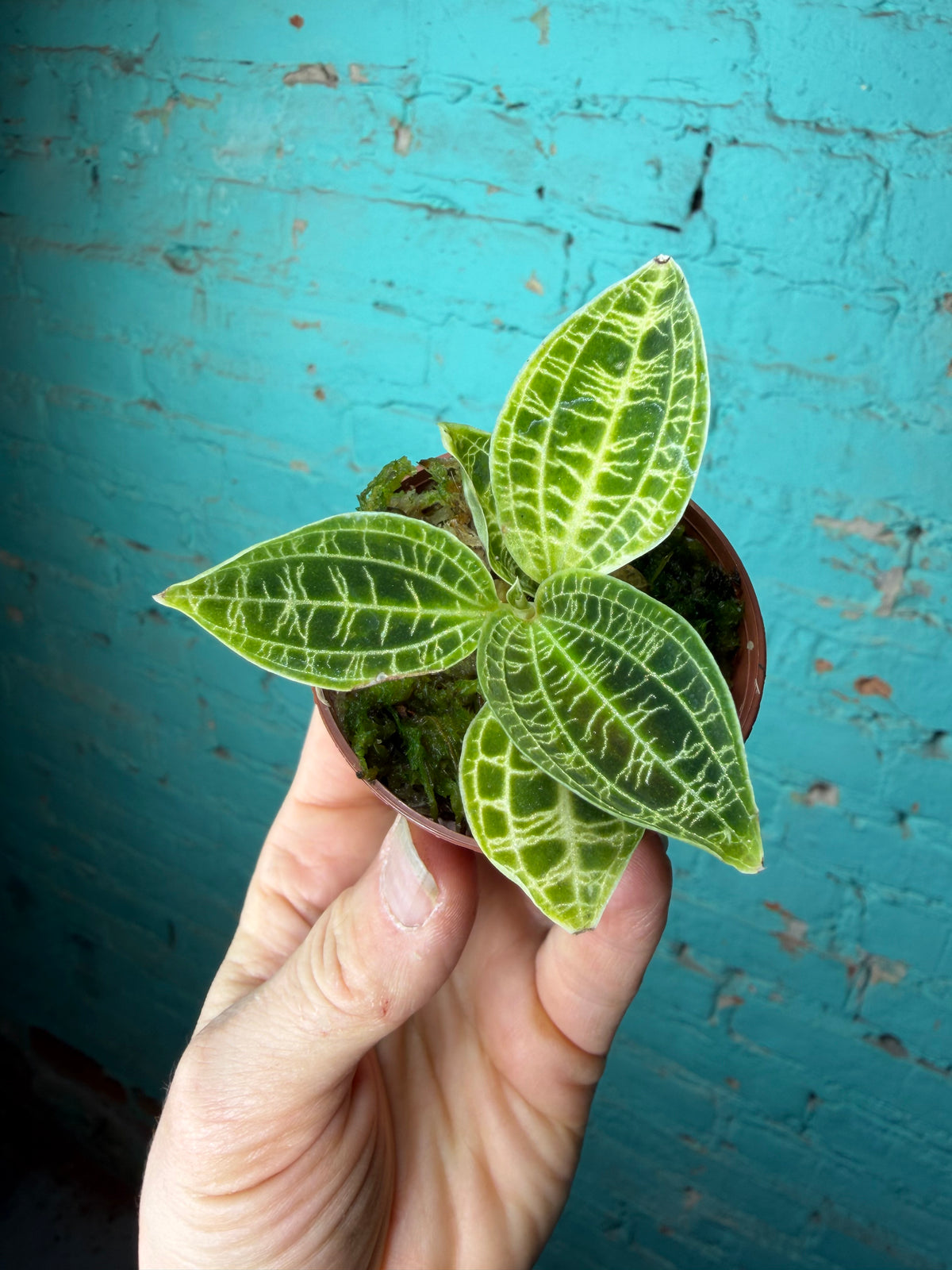
Each plant is unique. Size, shape, fullness, and variegation will vary.
Macodes petola | Lightning Jewel Orchid
Macodes petola is a terrestrial jewel orchid grown for its extraordinary foliage rather than its flowers. Its deep green, velvety leaves are covered with an intricate network of metallic gold to copper-colored veins that seem to sparkle as the angle of light changes, creating the lightning-like pattern behind its common name. This is a true orchid, but unlike many familiar orchids that grow attached to trees, it grows along the floor of warm, humid tropical forests in Southeast Asia and surrounding regions.
This plant develops along a fleshy, creeping rhizome that grows horizontally across the surface of its substrate. New leaves and roots develop along that stem, allowing an established plant to branch and gradually form a wider cluster. It stays relatively compact and does not need a moss pole or other vertical support. Mature plants can produce upright flower spikes with numerous small flowers, but the foliage remains the primary feature of this species.
For natural light indoors, place it approximately 1–3 feet from a north-facing window or 2–4 feet from an east-facing window. It prefers approximately 200–500 foot-candles at the leaves. Foot-candles simply tell you how much light is actually reaching your plant. This is a forest-floor orchid adapted to lower light than many tropical foliage plants. If the stems begin stretching, the spaces between leaves increase or successive leaves become smaller, check the amount of light reaching the plant and move it closer to the window. Pale or bleached areas developing on foliage exposed to stronger light can be a reason to increase its distance from the window.
Under a grow light, use a full-spectrum 5000–6500K fixture positioned approximately 12–18 inches above the foliage, aiming for the same 200–500 foot-candles at the leaves. Kelvin describes the color of the light, while foot-candles tell you how much light is actually reaching the plant. Keep the fixture above the plant so the growth remains compact and balanced, adjusting the distance as the plant grows or the intensity of the fixture changes.
Water when your plant needs watered. This jewel orchid naturally grows along a moist forest floor and prefers a root zone that remains lightly moist rather than repeatedly becoming completely dry. Its fine roots and creeping rhizome still need oxygen, so lightly moist does not mean keeping the substrate saturated. Allow some of the available moisture to be used before watering again, and pay attention to how quickly the substrate is changing rather than watering according to a schedule.
Its substrate is different from the coarse bark commonly used for epiphytic orchids. Long-fiber sphagnum moss can be used on its own, or it can be grown in a loose terrestrial jewel-orchid mix containing moisture-retentive materials such as sphagnum or coco coir combined with fine bark and perlite or pumice for additional air space. Straight sphagnum should remain loose and fluffy rather than tightly packed around the roots. The finished substrate should hold moisture while remaining porous enough for air to move through the root zone. Keep the creeping rhizome and growing points at or near the surface rather than burying them deeply, and use a container with drainage.
Watch the leaves, stems and substrate together. Loss of firmness accompanied by a drying root zone can indicate that the plant has used much of its available moisture. A substrate that remains saturated for an unusually long time, softening around the stem or deterioration of the rhizome is a reason to inspect the root zone before adding more water. Increasing spaces between leaves or progressively smaller new foliage can point toward insufficient light. Browning or damaged foliage can have several causes, so use those changes as clues to evaluate moisture, roots, humidity, temperature and light together rather than diagnosing the plant from a single symptom.
Success looks like compact growth, firm velvety leaves, healthy fine roots and a creeping rhizome that continues producing new foliage and branches. The metallic vein pattern is a natural feature of the leaves and does not require stronger light to develop. As the plant establishes, watch for consistent new leaves, compact spacing and continued expansion along the substrate. Those are better indicators of a supportive environment than whether or not the plant produces a flower spike.