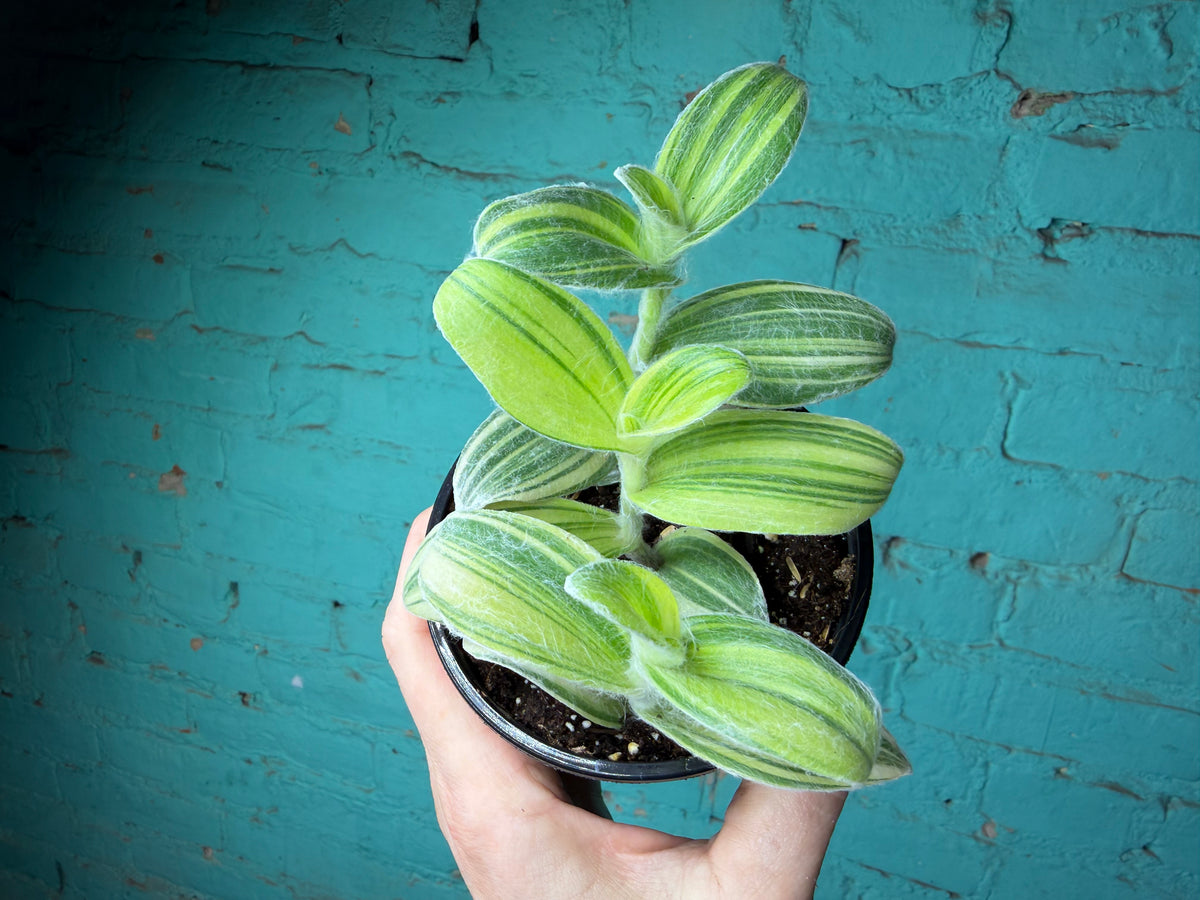
Each plant is unique. Size, shape, fullness, and variegation will vary.
Tradescantia sillamontana | White Velvet Tradescantia
Soft white hairs covering thick gray-green leaves give this Tradescantia an almost frosted appearance. That fuzzy coating is part of the plant itself, helping protect the foliage from intense sun and moisture loss in its naturally dry, rocky habitat in northeastern Mexico. The leaves grow tightly along fleshy stems, creating a chunky, almost succulent look that is very different from the thinner foliage of many familiar trailing Tradescantias. Small bright pink to magenta flowers can also appear near the ends of established stems.
This is a spreading and trailing plant with fleshy stems that root readily where nodes contact the growing medium. Young plants can stay fairly upright and compact, but the stems gradually lengthen, lean and travel outward as they mature. Pinching or pruning longer stems encourages additional branching and helps build a fuller plant. It works well in a hanging pot, on the edge of a shelf or allowed to spread across a wider container. Individual stems do not need support.
For natural light indoors, place it directly in an east-facing window or approximately 1–2 feet from a south-facing window. Aim for approximately 1,500–3,000 foot-candles at the leaves. Foot-candles simply tell you how much light is actually reaching your plant. This species naturally grows in much stronger light than many tropical Tradescantias, and good usable light helps keep the growth compact and the white hairs dense. If the spaces between leaves begin increasing, stems become thin or the plant starts losing its tight, chunky appearance, give it more usable light. Acclimate a plant gradually when moving it into much stronger direct sun so the existing foliage has time to adjust.
Under a grow light, use a full-spectrum 5000–6500K fixture positioned approximately 8–12 inches above the canopy, aiming for 1,500–3,000 foot-candles at the leaves. Kelvin describes the color of the light, while foot-candles tell you how much light is actually reaching the plant. Keep the fixture over the entire growing area rather than concentrating it over only the center of the pot, especially once stems begin spreading beyond the container.
Water when your plant needs watered. The thick leaves and fleshy stems give this species more ability to handle dryback than many of the softer-leaved Tradescantias. Allow the root zone to dry substantially before watering thoroughly again, then let excess water drain. Use a loose, fast-draining substrate with plenty of coarse perlite or pumice and other mineral material rather than a dense mix that remains wet for long periods. The white hairs can hold moisture against the foliage, so water the root zone rather than routinely soaking the leaves and give the plant good airflow.
Watch the spacing and thickness of the newest growth. Compact stems with leaves sitting relatively close together tell you the plant is receiving enough usable light. Longer bare sections between leaves, increasingly thin stems or greener, less densely covered growth are reasons to look at the light first. Softening or yellowing growth combined with a pot that remains wet for a long time points you back toward the root zone. The fuzzy white coating is normal and should remain on the leaves, so there is no reason to rub or clean it away.
Success looks like sturdy branching stems, compact spacing and thick leaves carrying their dense white covering. As stems lengthen, pruning can be used to shape the plant and the cuttings can root from their nodes to build an even fuller pot. With enough usable light and a root zone that is allowed to dry appropriately, this Tradescantia keeps the tight, silvery-white growth that makes it look so different from the rest of the genus.