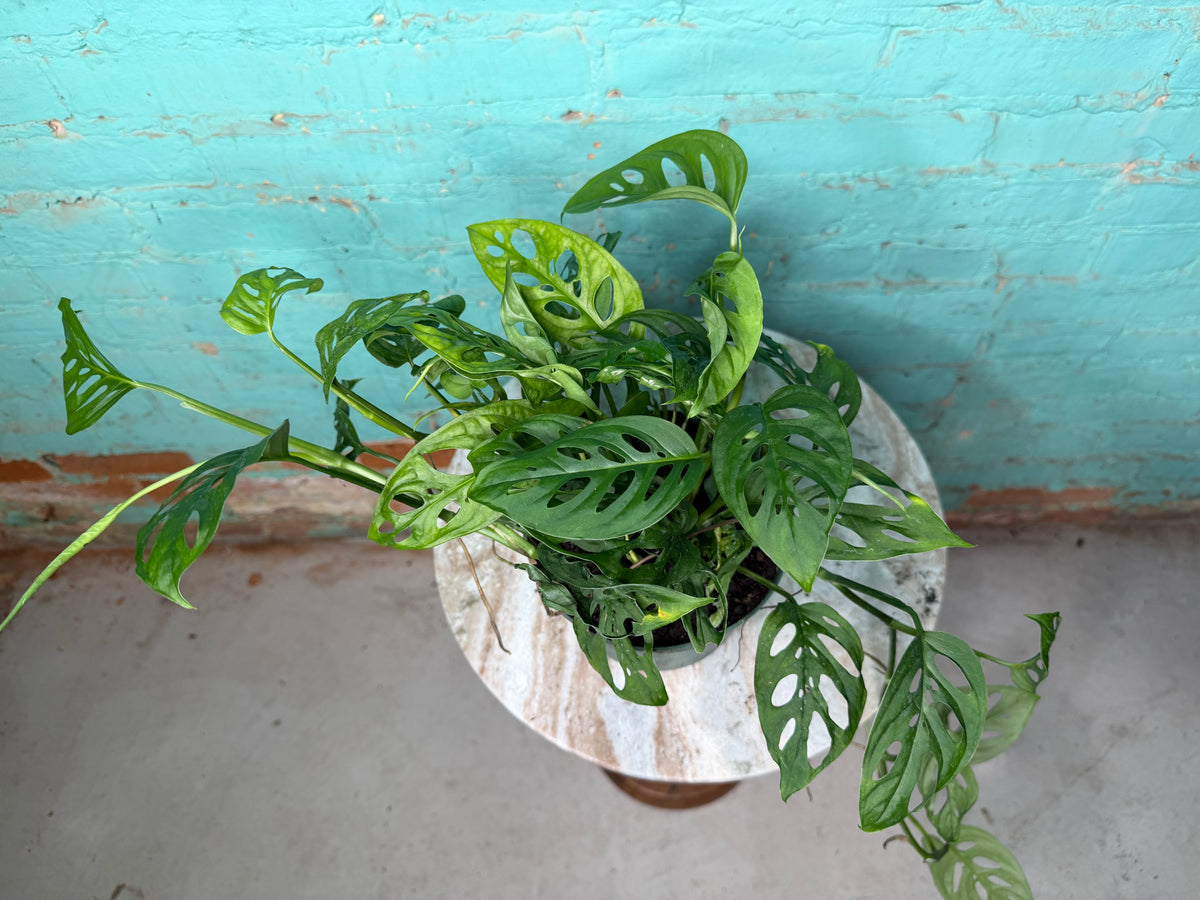
Each plant is unique. Size, shape, fullness, and variegation will vary.
Monstera adansonii
Swiss Cheese, Monstera adansonii, is a tropical climbing aroid native to parts of Central and South America. Its signature feature is the natural holes, called fenestrations, that develop inside the leaf rather than splitting all the way to the outer edge. Young leaves can begin smaller and with fewer openings, while a plant growing under supportive conditions can produce increasingly larger, more dramatically fenestrated foliage. It gives you the unmistakable Monstera look while staying much more manageable than the much larger Monstera deliciosa.
Swiss Cheese Vine is naturally a climber. In the wild, its stems use trees and other surfaces to move upward, producing aerial roots that help secure the plant as it climbs. Indoors, you can let it trail, but giving it a pole, plank or other vertical support allows it to grow more like it naturally would and can encourage larger, more mature foliage. If you want the plant to remain smaller and trailing, that’s perfectly fine too. Just understand that the way you grow it will influence what the mature plant looks like.
For natural light, start Swiss Cheese Vine approximately 1–3 feet from an east-facing window or 3–5 feet from a south-facing window. Swiss Cheese Vine prefers approximately 800–1,500 foot-candles at the leaves. Foot-candles simply tell you how much light is actually reaching your plant. Enough useful light supports stronger growth, closer spacing between leaves and continued development of larger, fenestrated foliage. Window direction and distance are starting points. Trees, overhangs, neighboring buildings, window size, season, screens and glass can all change how much light actually reaches your plant.
If you’re using grow lights, choose a 5000–6500K light and aim for the same approximately 800–1,500 foot-candles at the foliage. Kelvin tells you the color of the light, not its strength. Foot-candles tell you how much light is actually reaching the plant. There isn’t one correct number of inches between Swiss Cheese Vine and a grow light because different fixtures produce very different amounts of light. Measure at the leaves, especially as the plant begins climbing away from or toward the fixture.
Water when your plant needs watered. Swiss Cheese Vine likes to use moisture and then experience some dryback rather than remaining continuously saturated. Use an airy, well-draining mix that allows water and oxygen to move through the root zone. As the root system develops and the plant produces more foliage, its water use can increase considerably. Light matters here too. A vigorously growing plant receiving substantial useful light will move through water differently than the same plant sitting farther into a room.
Read the new growth. Increasingly long spaces between leaves, smaller new foliage or a plant reaching strongly toward its light source are reasons to check how much useful light is reaching it. Aerial roots are normal and are part of the plant’s climbing habit. If the plant is supported but new leaves aren’t gradually increasing in size or maturity, look at light and the overall growing environment before assuming the pole itself isn’t working. Soft or declining growth while the root zone remains wet is a reason to investigate how long the roots have been holding moisture rather than automatically watering again.
Success looks like active climbing growth, sturdy stems, healthy aerial roots and new leaves that gradually become larger and more developed. On a supported plant, you may see increasingly dramatic fenestrations as it matures. A trailing plant may remain smaller, and that doesn’t mean you’re growing it incorrectly. Decide what you want the plant to become, give it the environment to support that growth habit, and watch what the newest leaves are telling you.