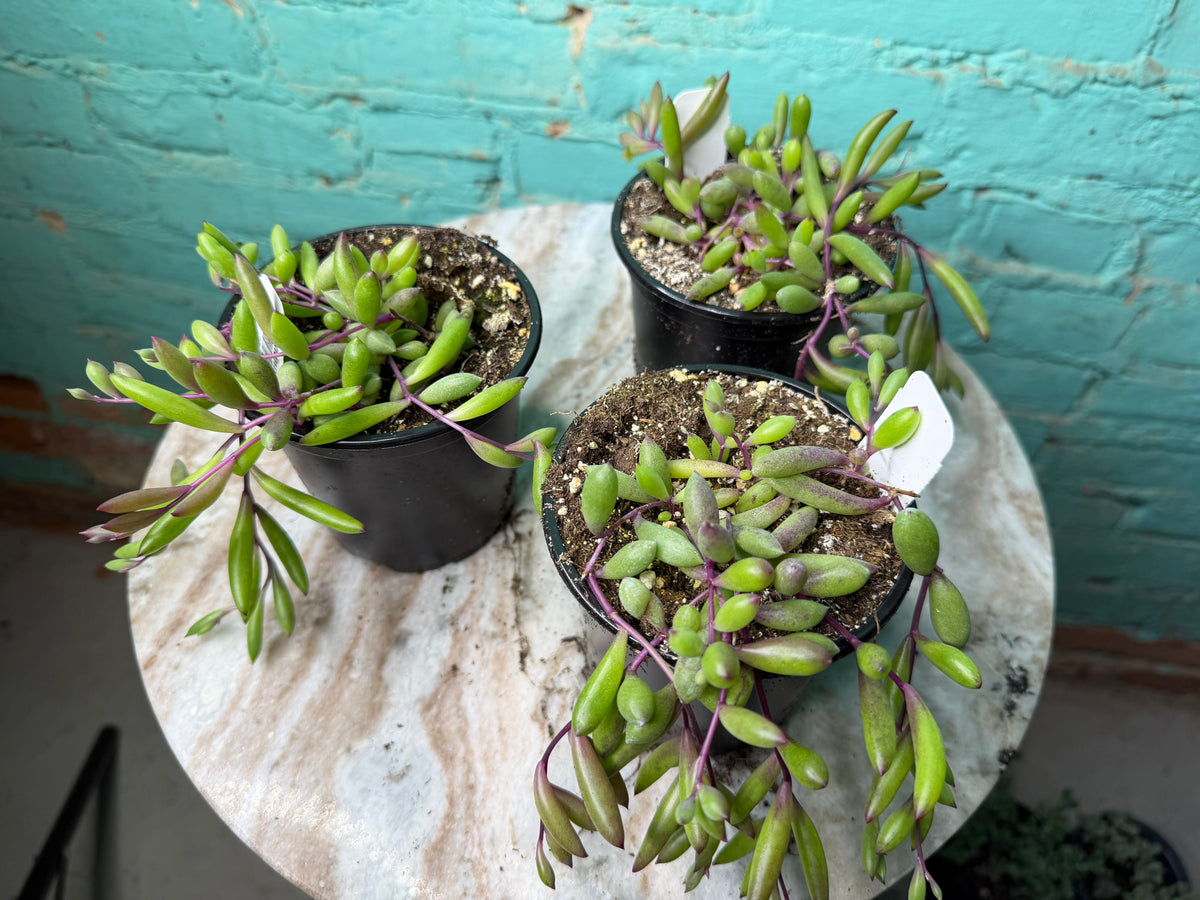
Each plant is unique. Size, shape, fullness, and variegation will vary.
String of Rubies, Crassothonna capensis, is a trailing succulent native to South Africa’s Cape Provinces. You may still see it labeled Othonna capensis, which is its older botanical name. Its fleshy, elongated leaves grow along slender stems that can develop beautiful purple and ruby coloring. Stronger light can bring out considerably more of that color, while plants grown under lower light may remain mostly green. The combination of colorful stems, succulent foliage and long trailing growth is what makes this plant stand out.
String of Rubies naturally develops long, spreading stems rather than remaining upright. As those stems lengthen, they spill over the container and can create a substantial trailing plant. It does not need a pole or vertical support. In nature, this species grows in sandy areas, scrub, dunes and dry rocky flats, which gives us some useful information about how it wants to grow: plenty of useful light, excellent drainage and a root zone that isn’t sitting wet.
For natural light, start String of Rubies directly in a south-facing window or approximately 1 foot from a west-facing window. String of Rubies prefers approximately 2,000–4,000 foot-candles at the leaves indoors. Foot-candles simply tell you how much light is actually reaching your plant. Stronger useful light helps maintain compact growth and can encourage the deeper ruby and purple coloring this plant is known for. Window direction and distance are starting points. Trees, overhangs, neighboring buildings, window size, season, screens and glass can dramatically change how much light actually reaches the plant.
If you’re using grow lights, choose a 5000–6500K light and aim for the same approximately 2,000–4,000 foot-candles at the foliage. Kelvin tells you the color of the light, not its strength. Foot-candles tell you how much light is actually reaching the plant. There is no universal number of inches between this plant and a grow light because fixtures vary tremendously in output. Measure the light where the foliage is actually growing, especially as the stems begin hanging farther below the fixture.
Water when your plant needs watered. Those fleshy leaves are water storage, so allow String of Rubies a substantial dryback before thoroughly watering again. Use a coarse, well-draining succulent mix and a container that allows excess water to leave freely. This plant is far more comfortable using the moisture stored in its leaves than sitting for long periods in a saturated root zone.
The leaves and spacing between them will tell you quite a bit. Well-hydrated foliage should feel fleshy and substantial. As the plant uses its stored water, the leaves can become less firm, which is a reason to check the root zone. Longer spaces between leaves, thinner growth and increasingly green stems are reasons to investigate whether the plant is receiving enough useful light. Color alone isn’t a diagnosis, but it can be another piece of information when you’re reading the plant.
Success looks like sturdy trailing stems, plump foliage, relatively compact spacing and active branching. Under stronger light, those stems and leaves may develop increasingly rich purple and ruby tones. String of Rubies can also produce small daisy-like flowers. Watch the new growth rather than expecting every older leaf to remain perfect. Dense, substantial new growth is a good indication that the plant is moving in the right direction.