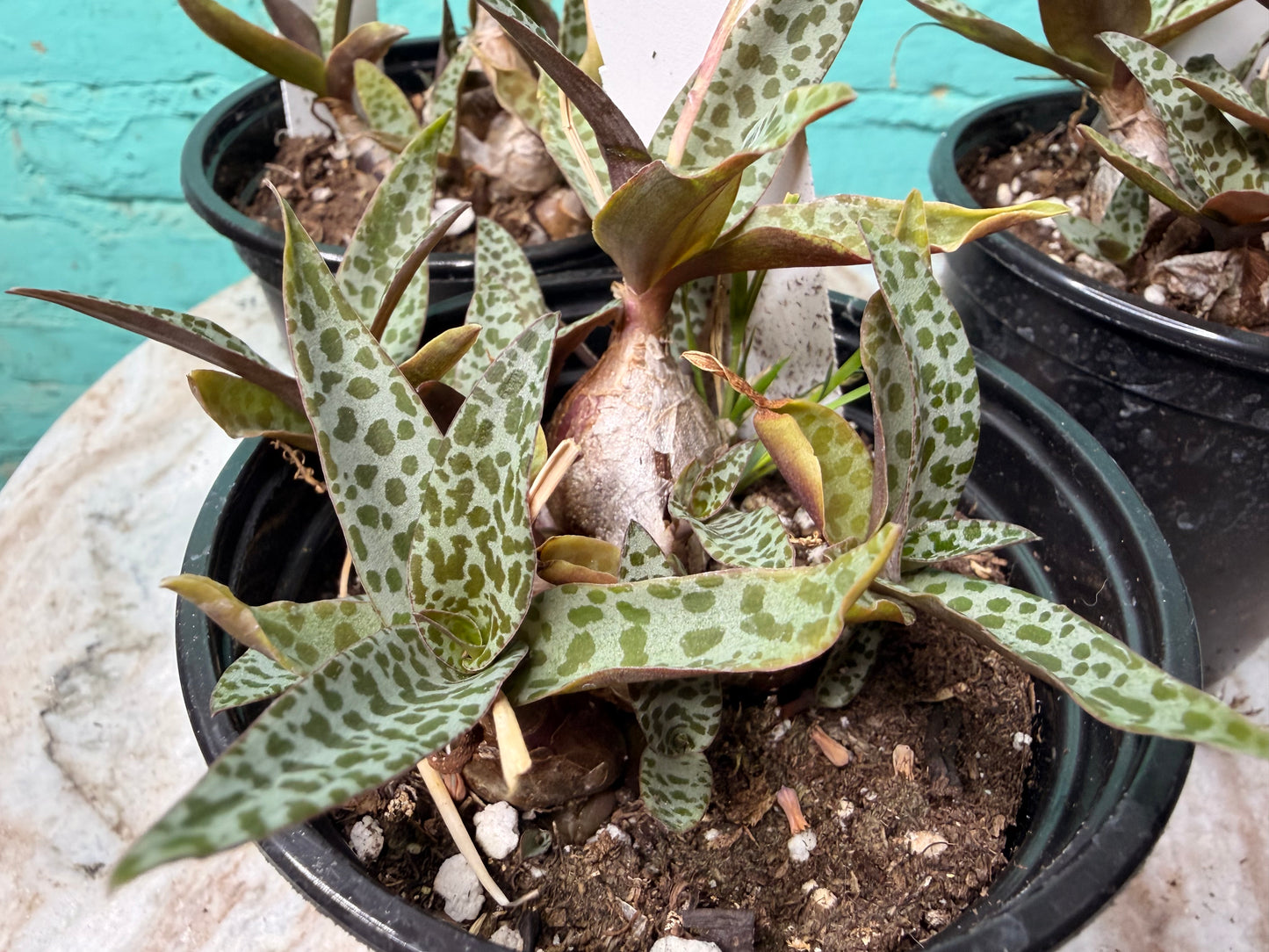
Each plant is unique. Size, shape, fullness, and variegation will vary.
Couldn't load pickup availability
Scilla violacea, now classified as Ledebouria socialis, is a bulb-forming succulent native to South Africa. It is prized for its silver leaves covered in dark green spots and its rich purple undersides, giving it year-round ornamental appeal. The plant grows from small bulbs that readily produce offsets, eventually forming dense clumps. In spring, mature plants send up slender flower stalks covered with small greenish-white to pink flowers. Its unique foliage and compact growth make it a favorite for windowsills and succulent collections.
Place Ledebouria socialis within 1–3 feet of an east-facing or south-facing window. Bright light helps maintain the silver coloration, bold spotting, and compact growth. Under grow lights, use a full-spectrum bulb in the 5000K–6500K range. High-output lights should be positioned 8–12 inches above the foliage, while medium-strength lights work best at 10–14 inches. Lower light levels often result in longer, weaker leaves and less vibrant coloration.
Water when the root zone has dried thoroughly, never on a schedule. Use a chopstick, moisture meter, or clear nursery pot to determine when the roots are ready for water. Plant in a fast-draining mix of equal parts succulent soil, coarse orchid bark, and perlite to provide excellent drainage and airflow. The bulbs store water, allowing the plant to tolerate dry periods much better than consistently wet soil. Avoid allowing water to remain around the bulbs for extended periods, as prolonged moisture can lead to bulb and root rot.
Ledebouria socialis communicates through both its foliage and bulbs. Firm, upright leaves with bright silver coloring and distinct spotting indicate the plant is healthy. If the leaves become long, floppy, or lose their silver coloration, the plant is asking for more light. Soft or yellowing leaves accompanied by persistently wet soil often signal the bulbs are remaining too moist. As the plant matures, it will naturally produce new offsets around the base, and increasing numbers of bulbs are a strong indication that it is thriving in its growing conditions.