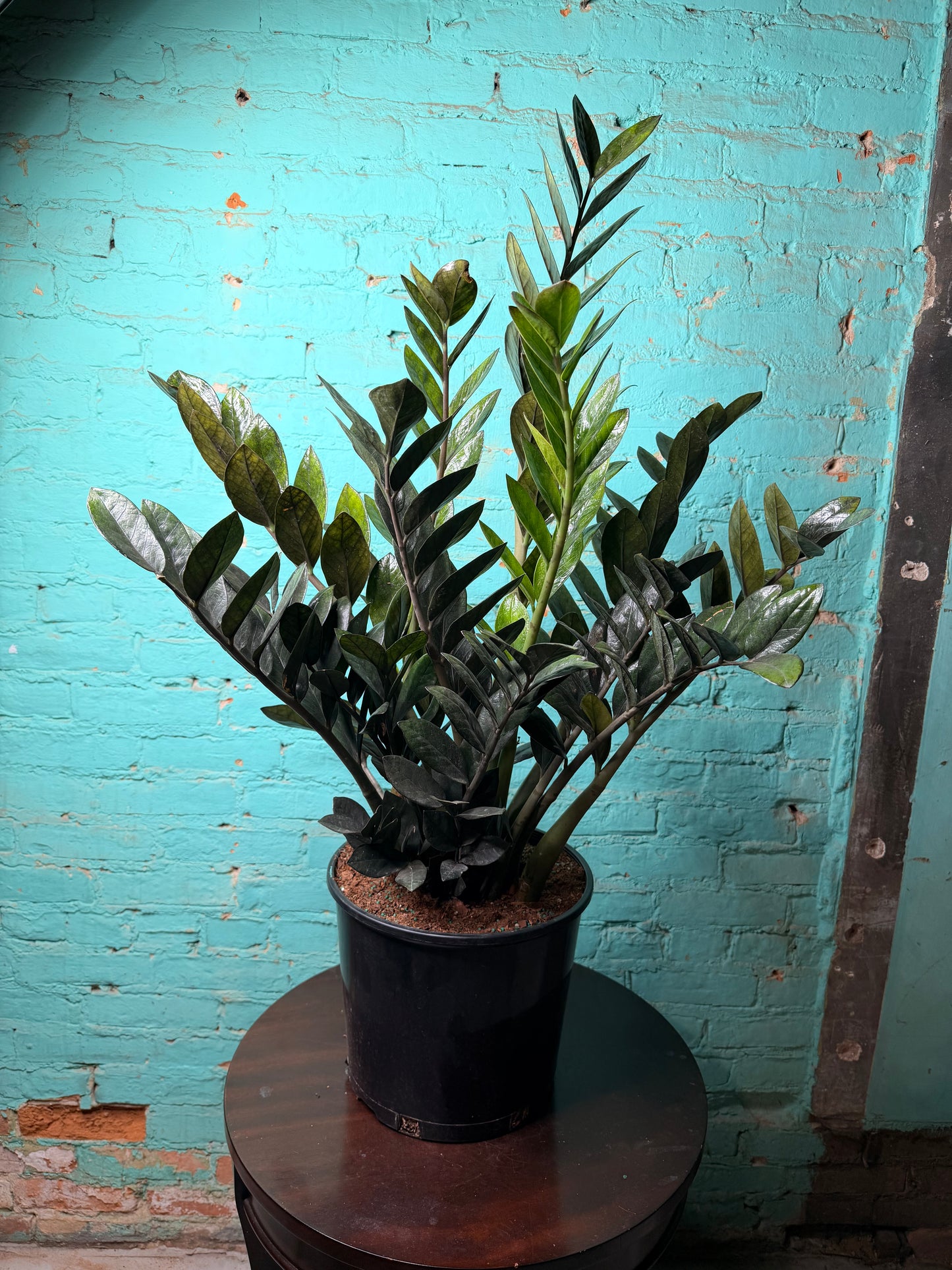
Each plant is unique. Size, shape, fullness, and variegation will vary.
Bright lime-green new growth rising through nearly black mature foliage is what makes Raven ZZ so much fun to grow. Every new compound leaf begins green and gradually darkens through deeper shades as it hardens until the foliage becomes extremely dark green to nearly black. That means an established plant can display completely different colors at the same time. The patented cultivar name is ‘Dowon’, originating from a naturally occurring mutation discovered in South Korea, while Raven is the name most commonly associated with the plant in cultivation.
All of that dramatic foliage begins below the soil. Thick rhizomes produce individual compound leaves, each carrying multiple glossy leaflets. A new leaf emerges as a bright green spear, gradually opens and then begins its transformation toward black. As the rhizomes expand and produce additional growth points, the plant develops into a dense upright clump. It does not climb and needs no vertical support. Growth often comes in flushes, so several new green spears may appear after a long period with little visible activity.
For natural light indoors, place it 1–3 feet from an east-facing window or 2–4 feet from a west-facing window. Aim for approximately 500–1,000 foot-candles at the leaves. Foot-candles simply tell you how much light is actually reaching your plant. Raven can tolerate lower light, but growth and water use can become extremely slow there. The nearly black mature foliage is genetic, so stronger light is not what turns a green leaf black. A bright green new shoot is exactly what you should expect, and it will darken naturally as the leaf matures.
Under a grow light, use a full-spectrum 5000–6500K fixture positioned approximately 10–14 inches above the canopy, aiming for 500–1,000 foot-candles at the leaves. Kelvin describes the color of the light, while foot-candles tell you how much light is actually reaching the plant. There is no reason to push Raven into extremely high light to chase darker foliage. Give it enough usable light to support strong growth and healthy rhizomes, then allow the plant’s natural color progression to do the rest.
Water when your plant needs watered. Allow the root zone to dry substantially before watering thoroughly again. The thick rhizomes and fleshy roots hold significant amounts of stored water, and Raven’s naturally slow growth can make it particularly easy to water again before the plant has used what is already available. Use a loose, fast-draining substrate containing plenty of coarse bark, pumice or perlite and a container with drainage. When repotting, keep the rhizomes at or very near the soil line rather than burying them deeply. Mature rhizomes can naturally push upward as the plant expands, and a firm healthy rhizome becoming visible at the surface does not need to be buried under additional soil.
Two things are particularly easy to misread on Raven: its color and its rhizomes. Green new growth does not mean the plant is reverting. Give the leaf time to harden and watch the color change. Below the soil, healthy rhizomes should remain firm and substantial. If the pot remains wet for an unusually long time and a sturdy stalk begins yellowing, softening or collapsing at the base, inspect the roots and rhizomes. Prolonged wet conditions can cause rhizome rot, and once that storage structure deteriorates, the foliage attached to it can collapse surprisingly quickly.
Success looks like firm rhizomes, sturdy upright foliage and several stages of color existing on the plant at once. A bright green spear beside olive-green developing foliage and nearly black mature leaves is exactly what Raven is supposed to look like. Long pauses between new shoots can be completely normal. When the underground system is healthy and established foliage remains strong, patience is often all this plant needs before the next flush appears.