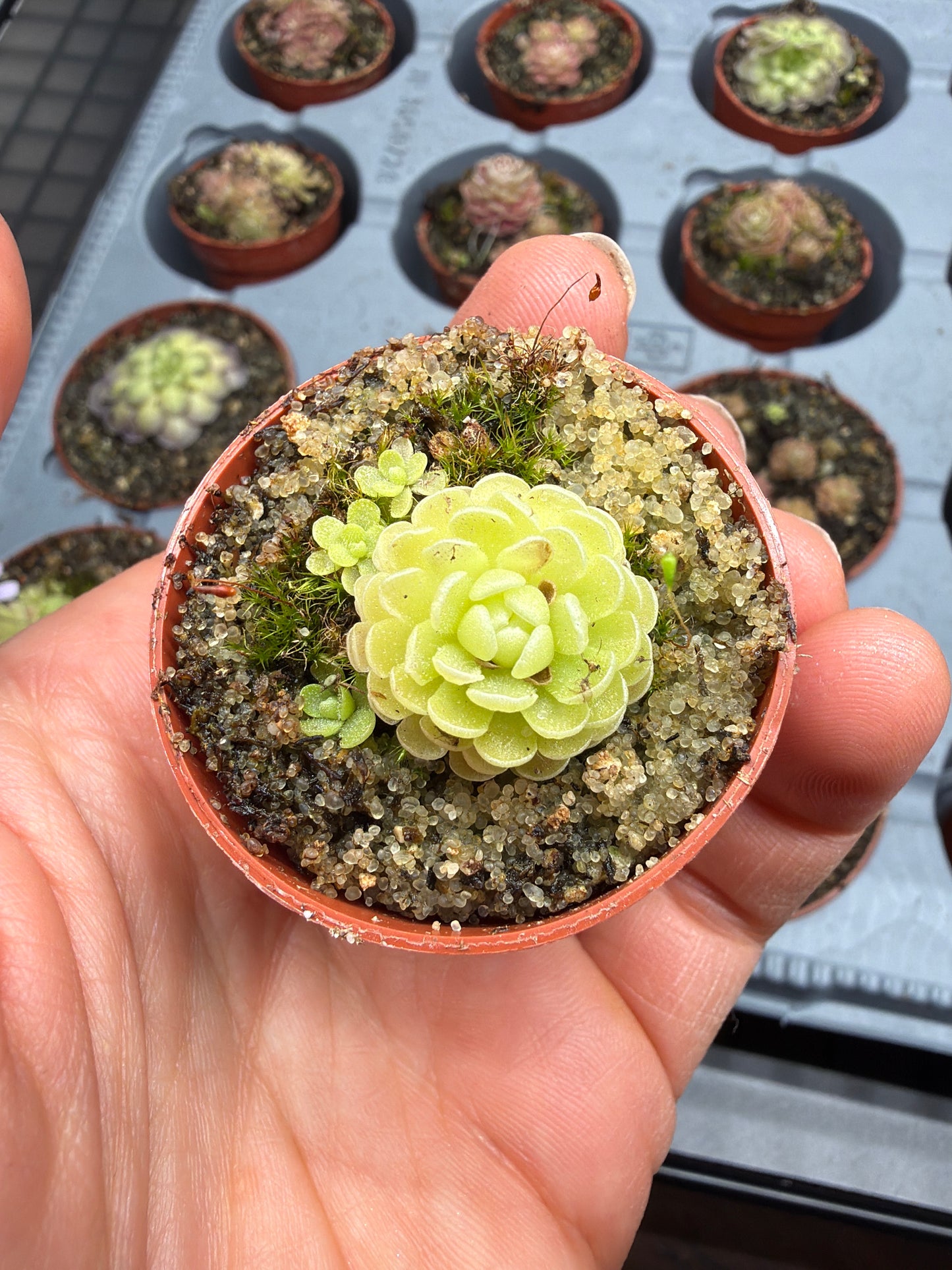
Each plant is unique. Size, shape, fullness, and variegation will vary.
Pinguicula esseriana | Esseriana Butterwort
Tiny, densely layered lime-green rosettes give this Mexican butterwort an almost miniature flower-like shape, even while it is actively carnivorous. The carnivorous leaves are rounded, fleshy and covered with fine glands that produce sparkling droplets of sticky mucilage. This green form can remain fresh lime to yellow-green throughout active summer growth rather than developing the stronger pink and red coloration seen in some other esseriana plants and forms. Its incredibly small size, tidy growth and ability to form clusters of offsets make it especially fun to grow as a little colony over time.
This is a genuinely miniature species. During active carnivorous growth, the rosette remains compact and can still look surprisingly succulent because the leaves overlap closely around the center. Compact growth by itself does not mean the plant has entered its succulent phase. Look at the leaves themselves. Broad, glandular leaves producing mucilage are active carnivorous growth, even when the entire plant is only a couple of inches across. It can also produce offsets readily around the mother plant, eventually creating a cluster of individual rosettes.
For natural light, place it directly in an east-facing window or approximately 1–2 feet from a south-facing window. Aim for approximately 1,000–2,000 foot-candles at the leaves during active carnivorous growth. Foot-candles simply tell you how much light is actually reaching your plant. This green form can remain beautifully lime green under strong usable light, so color alone should not be used to decide whether it needs more light. Watch the density of the rosette, steady center growth and production of healthy carnivorous leaves instead.
Under a grow light, use a full-spectrum 5000–6500K fixture approximately 6–10 inches above the rosette, aiming for roughly 1,000–2,000 foot-candles at leaf level. Kelvin describes the color of the light, while foot-candles tell you how much light is actually reaching the plant. Keep the fixture positioned over the rosette and adjust its height as needed so the plant continues receiving useful light directly across the crown.
Water when your plant needs watered. Use distilled water, reverse-osmosis water or rainwater. During active carnivorous growth, thoroughly wet the plant and its shallow upper root zone from above in the morning and evening rather than keeping the pot continuously standing in water. The root system is remarkably small and sits very close to the surface, so the goal is to keep moisture available in that shallow root zone while maintaining plenty of air through the substrate. As the plant moves into its succulent growth phase, its water use decreases. Follow the newest growth from the center and reduce moisture along with the plant.
Use a small, shallow pot with the crown resting at the substrate surface. A good mix is approximately 50% organic peat moss and 50% coarse mineral material, with horticultural pumice and natural aquarium sand or fine gravel making up the mineral portion. The finished mix should be visibly gritty, open and well aerated. Do not be surprised by how little root is underneath the plant when you repot or divide it. The tiny, shallow root system is normal.
During carnivorous growth, the sparkling droplets covering the leaves are mucilage produced by the plant’s feeding glands. Tiny insects such as fungus gnats can become trapped on the foliage and provide nutrients to the plant. Leave the sticky surface alone and allow captured insects to remain. Dead insects do not need to be removed from the leaves.
For the Rooted growing method, Schultz Cactus Plus Liquid Plant Food 2-7-7 is added to the regular distilled-water batch during active carnivorous growth at one full dropper per ½ gallon of water. This dilute solution is used when wetting the plants from above, allowing the carnivorous foliage to receive nutrients through its leaf surface as part of the regular watering routine.
The seasonal change in this species is easiest to understand by watching the center rather than watching its color. During active carnivorous growth, new leaves are broader and glandular and produce the sticky surface that catches prey. As the plant transitions, the newest leaves become smaller, thicker and increasingly tightly packed. Mucilage decreases on the new foliage as the compact succulent rosette develops. The older carnivorous leaves can remain around the outside during the transition before naturally aging away. When active carnivorous growth resumes, broader glandular leaves begin appearing from the center again.
Success can look different depending on the plant’s current growth phase. During carnivorous growth, look for fresh lime-green glandular leaves, visible mucilage, steady center growth and a compact rosette. Offsets around the mother plant are normal and can eventually turn one tiny plant into a cluster. During succulent growth, look for healthy, tightly packed new leaves even though the plant may become considerably smaller. As the seasons change again, the center will show you the transition first. Follow that newest growth and let the plant tell you what it is doing.