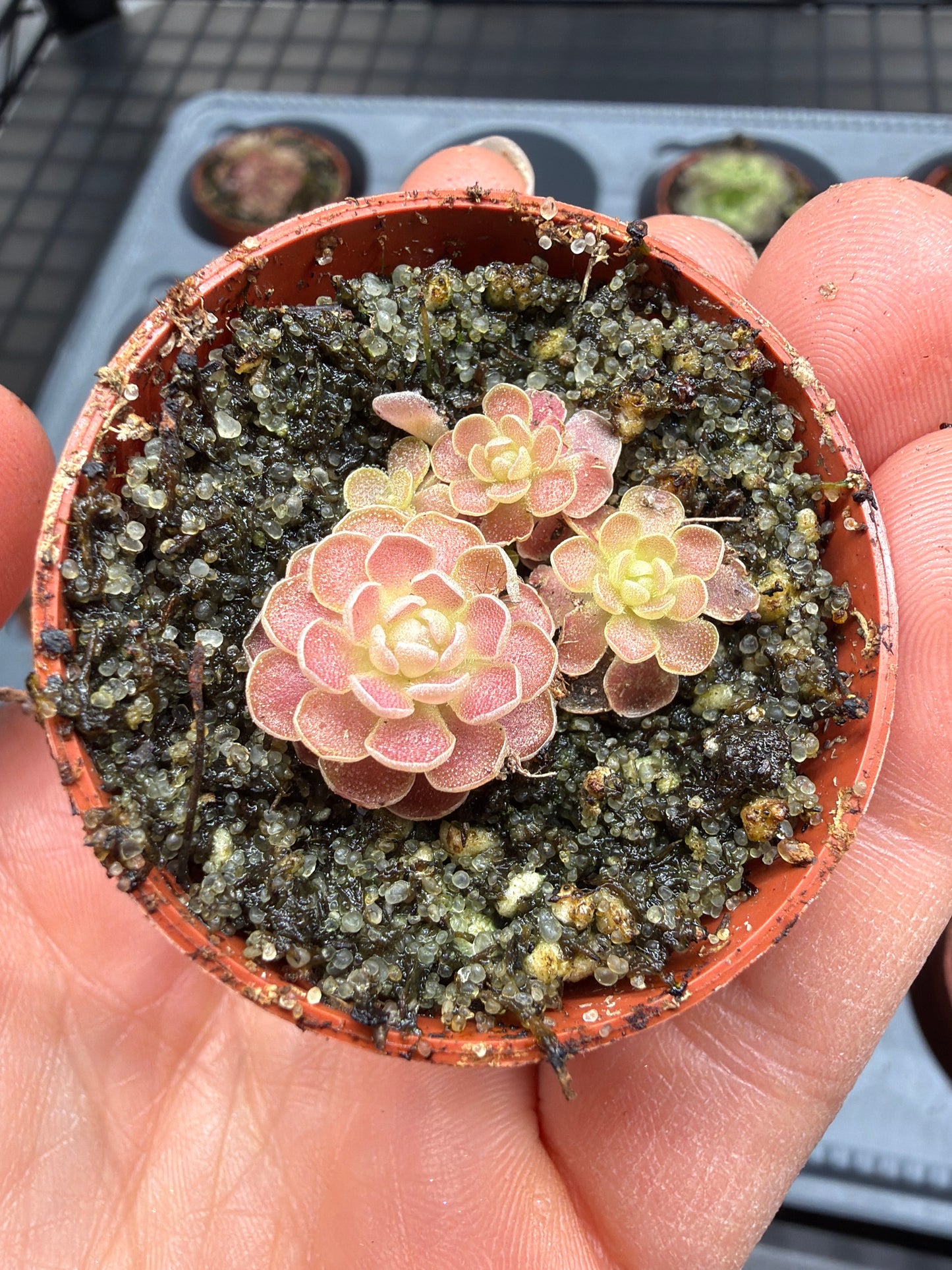
Each plant is unique. Size, shape, fullness, and variegation will vary.
Pinguicula esseriana | Esseriana Butterwort
Tiny, tightly layered leaves give this Mexican butterwort an almost miniature succulent appearance, while stronger usable light can bring beautiful pink, rose and reddish tones into the rosette. During active carnivorous growth, the leaves become broader and are covered in sparkling mucilage glands that capture fungus gnats and other very small insects. This is a naturally compact species from San Luis Potosí, Mexico, and its dramatic change between carnivorous and succulent growth makes it especially fun to watch throughout the year.
Even at maturity, this remains a small, compact Ping. During active growth, it produces fewer but substantially larger carnivorous leaves, with individual leaves reaching roughly ¾ inch across at their broadest point. As the season changes, those leaves are replaced by a much denser rosette containing numerous tiny succulent leaves. The roots underneath remain extremely fine and shallow, so a small root system beneath an otherwise healthy plant is completely normal.
For natural light indoors, place it directly in an east-facing window or approximately 1–2 feet from a south-facing window, aiming for approximately 1,000–2,000 foot-candles at the leaves. Foot-candles simply tell you how much light is actually reaching your plant. Strong usable light supports its compact shape and can encourage considerably more pink and reddish coloration. Color can change with light, temperature and growth phase, so evaluate the newest leaves along with the color of the rosette.
Under a grow light, use a full-spectrum 5000–6500K fixture approximately 6–10 inches above the rosette, aiming for 1,000–2,000 foot-candles at the leaves. Because this is such a small plant, make sure it is actually positioned beneath the useful portion of the fixture rather than assuming nearby light is enough. If you’re increasing its light substantially, allow the plant to adjust gradually.
Water when your plant needs watered. Use distilled water, reverse-osmosis water or rainwater. During active carnivorous growth, wet the plant and upper root zone thoroughly from above in the morning and again in the evening. This is more than a light mist. The foliage and substrate surface are actually wetted so moisture reaches the extremely shallow roots while the open substrate beneath them remains aerated. The pot does not need to remain continuously standing in water.
Give those tiny roots a loose, open substrate made from approximately half organic peat moss and half coarse mineral material. The mineral portion can include coarse pumice along with natural aquarium sand or fine gravel. The finished mixture should remain visibly gritty and open rather than dense or peat-heavy. Keep the crown at the surface and use a small, shallow pot. This species naturally maintains a very limited root system, so the amount of foliage above the substrate can be surprisingly large compared with what you find underneath.
During carnivorous growth, the sparkling droplets covering the leaves are mucilage. These sticky glands allow the plant to capture tiny insects and absorb nutrients from its prey. Fungus gnats and other small insects caught on the leaves can remain there while the plant uses them. There is no need to clean the leaves or remove the mucilage.
For additional nutrition, Rooted grows Pings using Schultz Cactus Plus 2-7-7 at one full dropper per ½ gallon of distilled, reverse-osmosis or rainwater. Mix it thoroughly into the water. During active carnivorous growth, this is the diluted water used when wetting the plants, allowing nutrition to reach the glandular foliage as part of their regular watering routine.
The succulent phase is particularly noticeable on this species. Watch the center of the plant as the transition begins. New leaves become much smaller, thicker and more tightly packed, eventually building a dense little rosette of numerous non-carnivorous leaves. The broad sticky foliage around the outside gradually ages away and the mucilage disappears as succulent growth takes over. At that point the plant can look like a completely different miniature succulent. Its water use drops considerably with this change, so follow the new growth and reduce moisture as the succulent rosette develops.
When active carnivorous growth returns, the change begins in the center again. New leaves become progressively larger and broader, and their glandular, sticky surface returns. Gradually increase moisture with the expanding carnivorous foliage and return to the regular active-growth feeding routine. Watching the center makes it possible to follow the plant’s cycle without depending on a particular month or date.
Flowers rise above the tiny rosette on slender stalks and are remarkably large compared with the plant beneath them. Blooms range from pale violet to deeper violet-purple, typically with a lighter throat and contrasting markings toward the center. They can be allowed to bloom normally while the rosette continues its growth below.
Success can look completely different from one phase to the next. During carnivorous growth, look for healthy broad leaves with visible mucilage and steady new growth from the center. During succulent growth, look for a dense, healthy little rosette continuing to build tightly packed fleshy leaves. When those larger sparkling leaves begin appearing again, your Ping is showing you that its next period of carnivorous growth has begun.