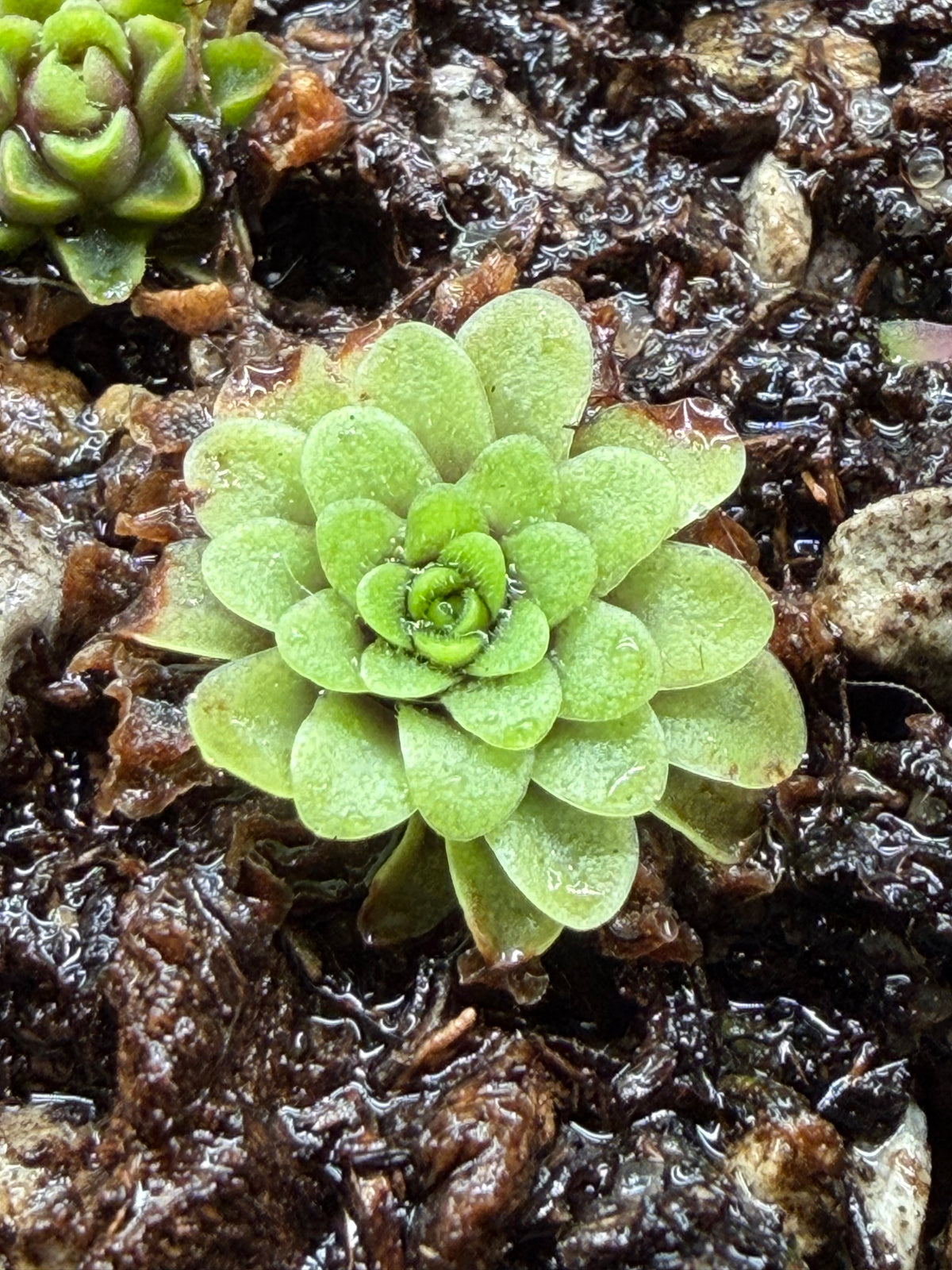
Each plant is unique. Size, shape, fullness, and variegation will vary.
The combination of broad, sparkling carnivorous leaves and rich red, burgundy and purple coloration makes this hybrid especially striking as it moves through its different growth phases. A cross between Pinguicula emarginata ‘Red’ and Pinguicula gypsicola, it brings together the broader leaf influence of emarginata with the narrower growth and strong seasonal change associated with gypsicola. Color can move from fresh green and yellow-green into bronze, burgundy and deep reddish purple, particularly through the newer growth under stronger usable light.
This is a compact rosette-forming butterwort with an extremely shallow root system. During active carnivorous growth, the leaves spread outward from the center and are covered with tiny glands that produce the characteristic sticky mucilage. As the plant begins moving toward succulent growth, its appearance changes from the center outward. New leaves become shorter, thicker and more tightly packed while the older carnivorous leaves may remain around the outside for quite some time. Watching what the center is producing gives you a much better picture of its current growth phase than judging the plant by overall size alone.
For natural light, place it directly in an east-facing window or approximately 1–2 feet from a south-facing window. Aim for approximately 1,000–2,000 foot-candles at the leaves during active carnivorous growth. Foot-candles simply tell you how much light is actually reaching your plant. Strong usable light supports compact growth and can encourage richer coloration, although the exact amount of red or burgundy a particular plant develops is also influenced by genetics and its current growth phase.
Under a grow light, use a full-spectrum 5000–6500K fixture positioned approximately 6–10 inches above the rosette, adjusting the fixture as needed to keep roughly 1,000–2,000 foot-candles reaching the leaves. Kelvin describes the color of the light, while foot-candles tell you how much of that light is actually reaching the plant. Keep the light over the rosette rather than off to one side so new growth develops evenly.
Water when your plant needs watered. Use distilled water, reverse-osmosis water or rainwater. During active carnivorous growth, thoroughly wet the plant and the shallow upper root zone from above in the morning and evening rather than keeping the pot continuously standing in water. These plants have remarkably small, shallow roots, so the goal is to keep moisture available where those roots actually are while maintaining plenty of air through the substrate. As the center begins producing its tighter succulent growth, the plant uses less water. Reduce moisture along with the plant and gradually increase it again when broader carnivorous growth begins returning from the center.
Use a small, shallow pot and keep the crown at the surface. A good starting mix is approximately 50% organic peat moss and 50% coarse mineral material, using horticultural pumice along with natural aquarium sand or fine gravel for the mineral portion. The finished substrate should look visibly open and gritty rather than dense or peat-heavy. Do not be concerned if you repot one and find surprisingly little underneath it. The tiny root system is normal for these plants.
During carnivorous growth, the sparkling droplets covering the leaves are mucilage. Tiny insects such as fungus gnats can become trapped on the leaf surface, where the plant can obtain nutrients from them. The droplets belong there, so leave the leaf surface alone and allow the plant to do what it was built to do. Dead insects caught on the leaves do not need to be removed.
For the Rooted growing method, Schultz Cactus Plus Liquid Plant Food 2-7-7 is added to the regular distilled-water batch during active carnivorous growth at one full dropper per ½ gallon of water. That dilute solution is used when wetting the plants from above, allowing the carnivorous foliage to receive nutrients through the leaf surface as part of the regular watering routine.
The seasonal transformation is one of the most interesting parts of growing this hybrid. The change begins in the center. You may still have large, sticky carnivorous leaves around the outside while the middle is already producing shorter, thicker and more closely stacked leaves. As that transition continues, mucilage production decreases on the new foliage and the center develops into a tighter succulent rosette. When active carnivorous growth returns, watch for the opposite change: new leaves emerging from the center begin broadening again and the glandular, sticky surface returns.
Success will not look exactly the same throughout the year. During carnivorous growth, look for fresh glandular leaves, visible mucilage, steady center growth and a compact, well-colored rosette. During the transition, look for an orderly change in the newest leaves while older foliage naturally ages around them. During succulent growth, a smaller, tighter center can be exactly what the plant is supposed to be doing. Keep watching the newest growth. It will tell you where the plant is headed next.