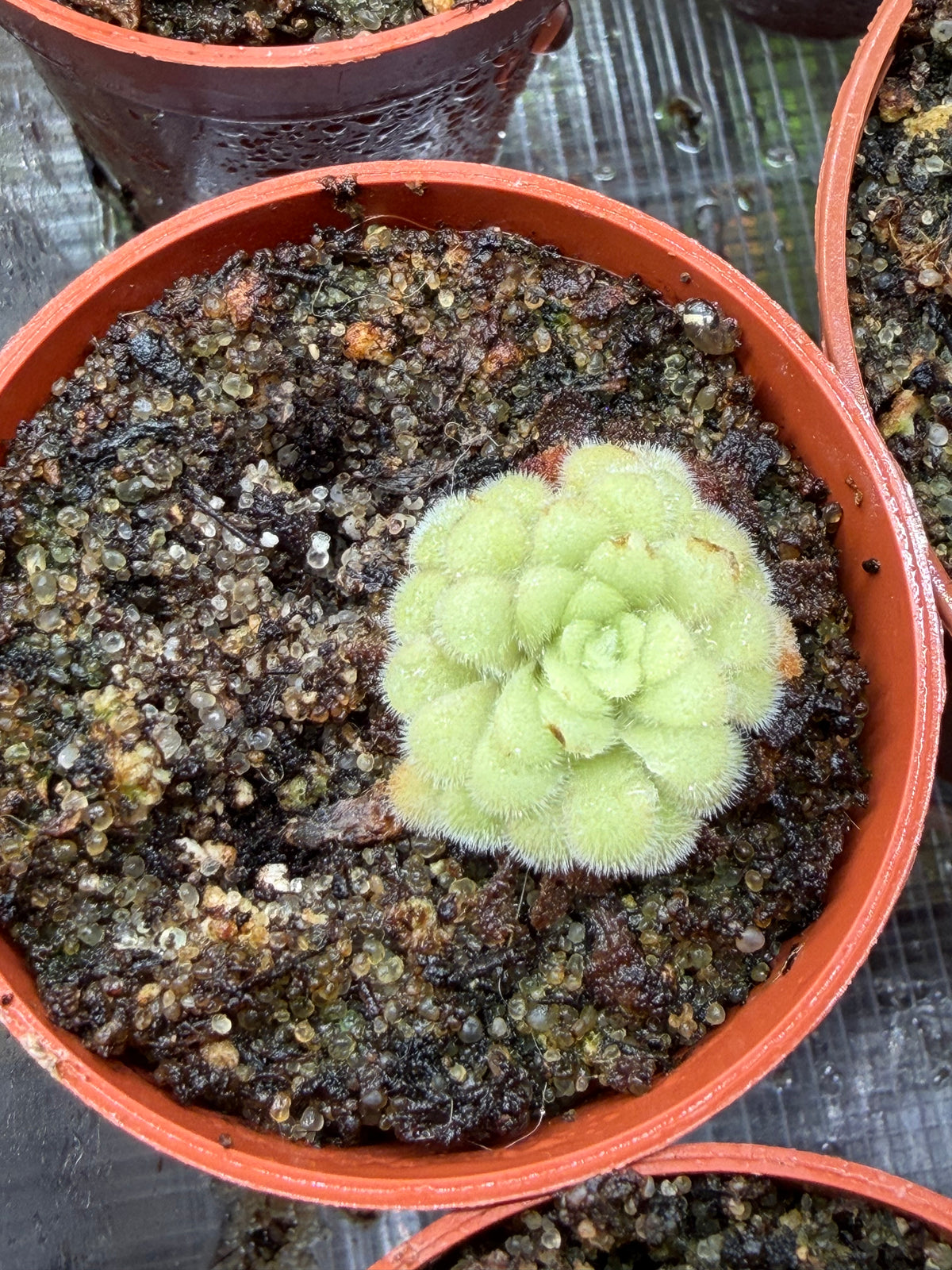
Each plant is unique. Size, shape, fullness, and variegation will vary.
Pinguicula gypsicola ‘Red’ | Red Gypsicola Butterwort
Long, narrow carnivorous leaves and the ability to develop beautiful red, bronze and pink tones give Red Gypsicola a completely different shape from the broad, rounded Pings. Pinguicula gypsicola is a Mexican species naturally associated with gypsum-rich rocky habitats, and its active-growth rosette can look almost starburst-like as the slender leaves radiate from the center. Each leaf is covered with tiny glistening glands that capture fungus gnats and other very small insects. The “Red” name describes a strongly colored form in cultivation rather than changing the underlying species.
This is a relatively small Ping, but its narrow leaves can create a rosette several inches across during active carnivorous growth. New leaves emerge from the center and extend outward while older foliage gradually moves toward the outside. Its root system is extremely small and shallow, which makes much more sense when you consider the rocky, mineral habitat this species naturally occupies. A tiny root system underneath a healthy rosette is completely normal. Watch the center because the newest leaves give you the clearest picture of what the plant is doing now.
For natural light indoors, place it directly in an east-facing window or approximately 1–2 feet from a south-facing window, aiming for approximately 1,000–2,000 foot-candles at the leaves. Foot-candles simply tell you how much light is actually reaching your plant. Strong usable light supports compact growth and can bring out more of the red, bronze and pink coloration this form is grown for. Color will still vary with growth stage and conditions, so look at the shape and quality of the newest leaves along with color when judging its placement.
Under a grow light, use a full-spectrum 5000–6500K fixture approximately 6–10 inches above the rosette, aiming for 1,000–2,000 foot-candles at the leaves. Keep the fixture centered over the plant so the entire rosette receives usable light. Increase intensity gradually if the plant has been growing under considerably weaker light. The goal is healthy compact growth first, with stronger coloration developing as the plant responds to its environment.
Water when your plant needs watered. For Pings at Rooted, that starts with distilled water, reverse-osmosis water or rainwater rather than mineral-heavy tap water. During active carnivorous growth, wet the plant and upper root zone from above in the morning and again in the evening. Its roots live very close to the surface, allowing moisture to remain available where the plant is actually using it while the open substrate stays aerated. The pot does not need to remain continuously standing in water.
Give those shallow roots a loose, open substrate made from approximately half organic peat moss and half coarse mineral material. The mineral portion can include coarse pumice and natural aquarium sand or fine gravel. This species naturally grows in strongly mineral, gypsum-associated environments, so an open root zone is particularly appropriate. The finished mix should look visibly gritty rather than peat-heavy. Keep the crown at the surface and avoid burying the center of the rosette.
During carnivorous growth, the sparkling droplets covering those narrow leaves are called mucilage. The plant produces them to capture tiny insects and absorb nutrients from its prey. Fungus gnats and other small insects caught across the leaves can simply remain there while the plant uses them. Avoid wiping or cleaning the sticky foliage. For additional nutrition, Rooted grows Pings using Schultz Cactus Plus 2-7-7 diluted at one full dropper per ½ gallon of distilled, RO or rainwater. Mix it thoroughly into the water and use the diluted solution during active carnivorous growth so the foliage receives nutrition as the plant is wetted.
The seasonal transformation of Pinguicula gypsicola can be especially dramatic. As it enters its succulent phase, watch the center of the plant. The long, narrow carnivorous leaves are replaced by much smaller, thicker, tightly packed leaves, and the sticky mucilage disappears as the new growth takes over. Eventually the plant can become a tiny compact succulent rosette that looks remarkably different from its spreading carnivorous form. This is a normal and important part of the species’ growth cycle. As the plant becomes smaller and its growth slows, reduce moisture along with its changing water use.
The plant will show you when carnivorous growth is returning. New leaves emerging from the center begin lengthening again and develop their sticky glandular surface. Gradually increase moisture as the active rosette expands and return to its regular carnivorous-growth feeding routine. With this species in particular, the shape of the newest leaves makes its current growth phase easy to read once you know what you’re looking for.
Flowers rise above the rosette on slender stalks and can be allowed to bloom normally. Older carnivorous leaves can decline as the succulent rosette develops, and older succulent leaves can eventually be replaced as active growth returns. Follow the center rather than judging the plant by the oldest leaves around its outside edge.
Success looks very different between the two phases, and that transformation is part of what makes Red Gypsicola so interesting to grow. During carnivorous growth, look for healthy narrow leaves radiating from the center with a glistening surface and increasingly strong coloration under good light. During succulent growth, look for a healthy, tightly packed center of small fleshy leaves. When those long sticky leaves begin returning, your plant is showing you that another season of carnivorous growth has begun.