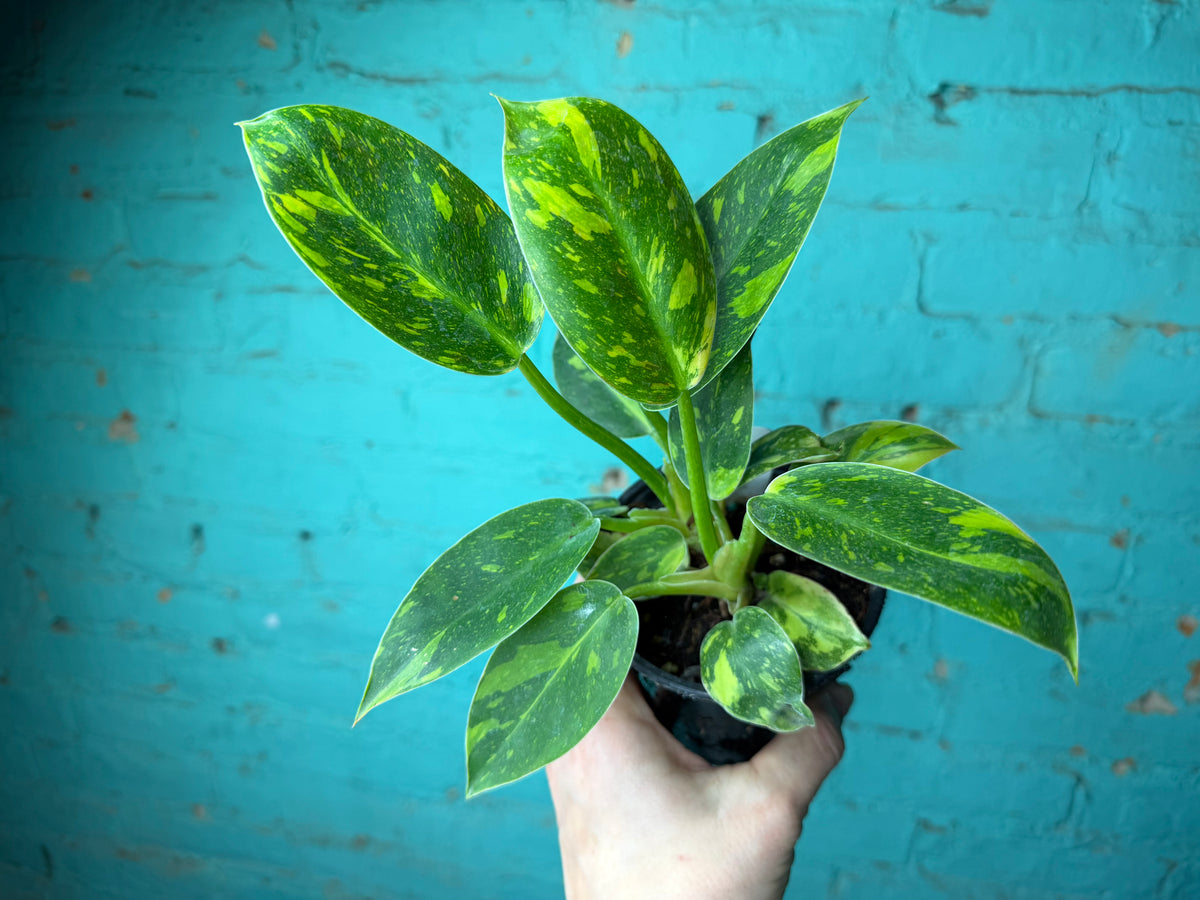
Each plant is unique. Size, shape, fullness, and variegation will vary.
Philodendron ‘Congo Nuclear’ | Congo Nuclear Philodendron
Wild marbling in cream, yellow, lime and multiple shades of green makes Congo Nuclear look different from leaf to leaf. Broad, glossy foliage can carry everything from fine mottling to larger irregular areas of pale color, while new growth may emerge with warm coppery tones before hardening into its mature pattern. It belongs to the compact, self-heading Congo group of Philodendrons. The exact breeding history behind the Nuclear form is not reliably documented, so I would treat ‘Congo Nuclear’ as the established horticultural trade name rather than assigning it a parentage that cannot be verified.
This is a self-heading Philodendron rather than a climbing one. New leaves build from a short central stem, gradually creating a broad, upright plant with substantial paddle-shaped foliage. As it matures, the crown becomes wider and the leaves considerably larger, but it does not need a moss pole or trellis to mature. Give the plant enough room around the crown for new leaves to open without being pressed against a wall, neighboring plants or shelving.
For natural light indoors, place it 1–3 feet from an east-facing window or 2–4 feet from a west-facing window. Aim for approximately 800–1,500 foot-candles at the leaves. Foot-candles simply tell you how much light is actually reaching your plant. The variegation is genetic, so stronger light does not create more cream or yellow. Good usable light does give the plant the energy it needs to support those lower-chlorophyll sections while continuing to produce substantial leaves. Watch the newest growth. Increasingly smaller leaves or a crown beginning to stretch toward the window are useful signs that the plant may need more usable light.
Under a grow light, use a full-spectrum 5000–6500K fixture approximately 8–12 inches above the canopy, aiming for 800–1,500 foot-candles at the leaves. Keep the fixture centered over the entire crown rather than directly over only the growth point. As the plant widens, coverage becomes just as important as distance. Kelvin describes the color of the light, while foot-candles tell you how much light is actually reaching the foliage.
Water when your plant needs watered. Allow it to use a good portion of the available moisture before watering thoroughly again, then allow excess water to drain. Use a loose aroid mix with potting soil or coco coir, chunky orchid bark and coarse perlite or pumice. The goal is a root zone that can hold enough moisture to support those large leaves while still allowing plenty of air around the roots. How quickly it uses water will change with its light, root system, pot size and how actively it is growing.
Pay attention to the newest leaf and the overall shape of the crown. New foliage can change considerably as it hardens, so give a fresh leaf time before deciding what its final color will be. Some leaves may carry considerably more green than others, and variation from leaf to leaf is part of what makes this plant interesting. If several successive leaves become smaller, internode spacing begins increasing or new growth repeatedly struggles to open cleanly, look at usable light, moisture consistency and root health together. Tender variegated areas can also brown more easily than the green portions of the leaf, especially when the plant has gone through an environmental change.
Success looks like a sturdy, full crown with substantial leaves and steady new growth. The balance of green, lime, yellow and cream will never be identical from one leaf to the next, and that unpredictability is part of the appeal. Keep your attention on whether the plant is continuing to produce strong leaves, maintain healthy roots and increase in size. A Congo Nuclear moving steadily forward does not need every new leaf to have the same amount or pattern of variegation.