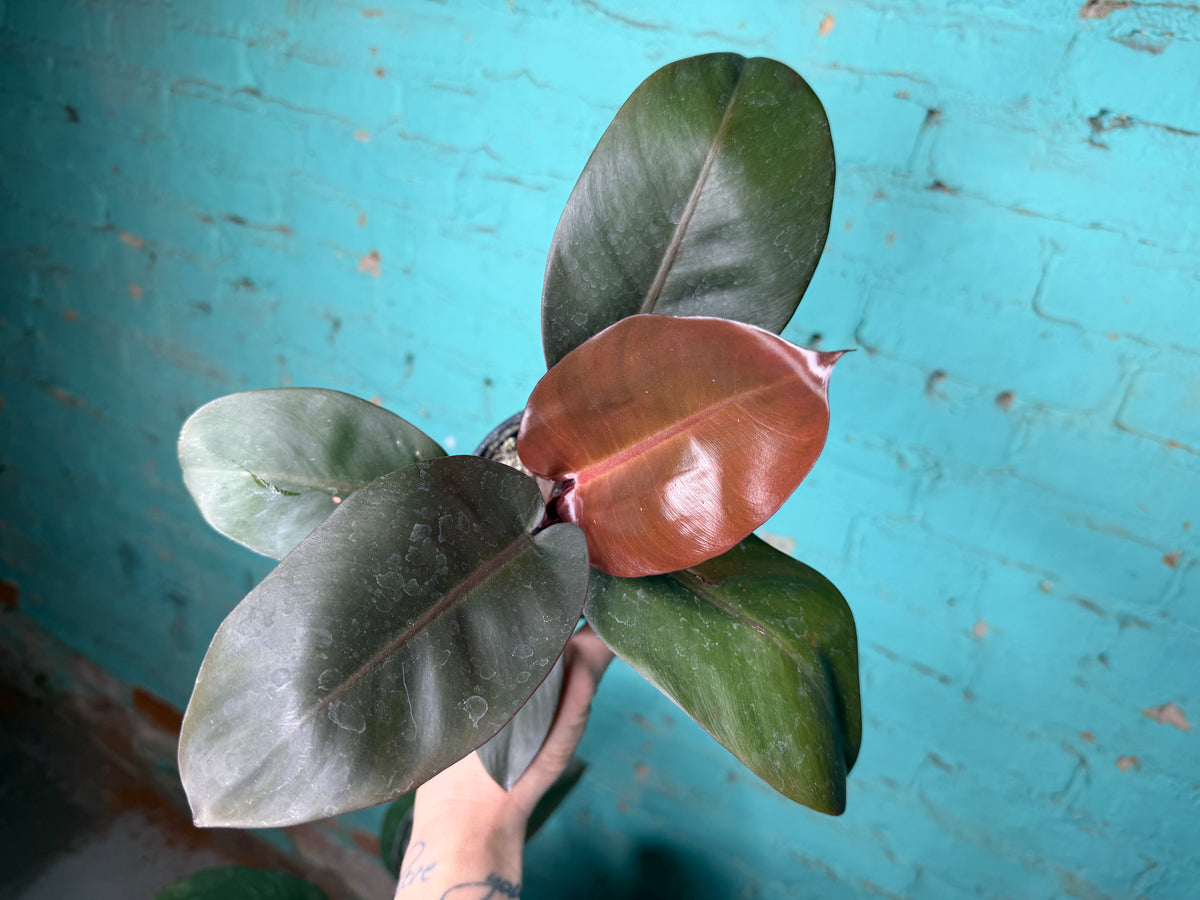
Each plant is unique. Size, shape, fullness, and variegation will vary.
Broad, thick leaves that deepen toward black-red as they mature are what make this hybrid different from the brighter orange and red self-heading Philodendrons. New foliage emerges brick red, then darkens dramatically rather than eventually fading to ordinary green. The leaves themselves are unusually substantial, with a thick, leathery texture, depressed veins and a slightly rippled surface that becomes more noticeable as they expand. ‘Black Cardinal’ was developed in Florida specifically through a breeding program seeking a compact Philodendron with exceptionally dark, durable foliage.
This is a true self-heading hybrid, and that compact structure is part of what it was bred for. Its broad leaves remain closely arranged around a short central stem rather than producing the long vine you would expect from a climbing Philodendron. As older leaves eventually shed, more of that short stem can become visible, but it still maintains a dense, relatively low and wide growth habit. Mature plants can reach approximately 2–3 feet tall and wide indoors. It does not need a moss pole to mature or increase its leaf size.
For natural light indoors, place it 1–3 feet from an east-facing window or 2–4 feet from a west-facing window. Aim for approximately 600–1,200 foot-candles at the leaves. Foot-candles simply tell you how much light is actually reaching your plant. This cultivar was selected in part for its ability to maintain its form and dark foliage indoors, so it does not need the same intensity I would target for a highly variegated Philodendron. At the lower end, growth may be slower and the plant may not develop the same depth of color or compactness. If newer leaves begin getting progressively smaller or the normally tight growth starts opening up, increase the usable light rather than assuming that continued growth means the current placement is ideal.
Under a grow light, use a full-spectrum 5000–6500K fixture positioned approximately 10–14 inches above the canopy, aiming for the same 600–1,200 foot-candles at the leaves. Its dark pigmentation is genetic, so the goal is not to blast the plant with light to make it black. Instead, provide enough usable light to support substantial leaves and maintain the dense growth this cultivar was selected for. Because the plant grows outward as much as upward, pay attention to coverage as it gets wider rather than keeping the fixture centered over only the newest leaf.
Water when your plant needs watered. Those thick leaves and relatively compact growth mean it may not move through water at the same rate as a thinner-leaved, rapidly climbing Philodendron. Allow a substantial portion of the available moisture to be used before watering again, then water the root zone thoroughly. Use a loose mix containing potting material for moisture retention along with chunky bark and perlite or pumice for air space. Pay particular attention to how quickly the pot dries after watering. A plant that was previously using its water efficiently but suddenly stays wet much longer is telling you something has changed in its light, roots, temperature or active growth.
Color is especially useful for reading this plant because leaf age naturally changes what you see. A newly opening brick-red leaf should darken as it hardens, while older foliage develops the deep red-black to blackish-green appearance characteristic of the cultivar. That normal progression should not be confused with leaf damage. What is more useful to watch is whether new leaves are reaching their expected size and whether the plant is maintaining its naturally close spacing. A series of increasingly small leaves or a noticeably looser crown deserves investigation even if the plant is technically still producing new growth.
Success looks like a dense plant carrying several generations of foliage, from brick-red emerging leaves to extremely dark mature leaves, with broad, thick blades held closely around the central growth point. This is not a Philodendron that needs to climb higher and higher to show you it is maturing. Its mature character is compact, broad, heavy and dark, and a plant that continues producing substantial leaves while maintaining that dense structure is doing exactly what ‘Black Cardinal’ was bred to do.