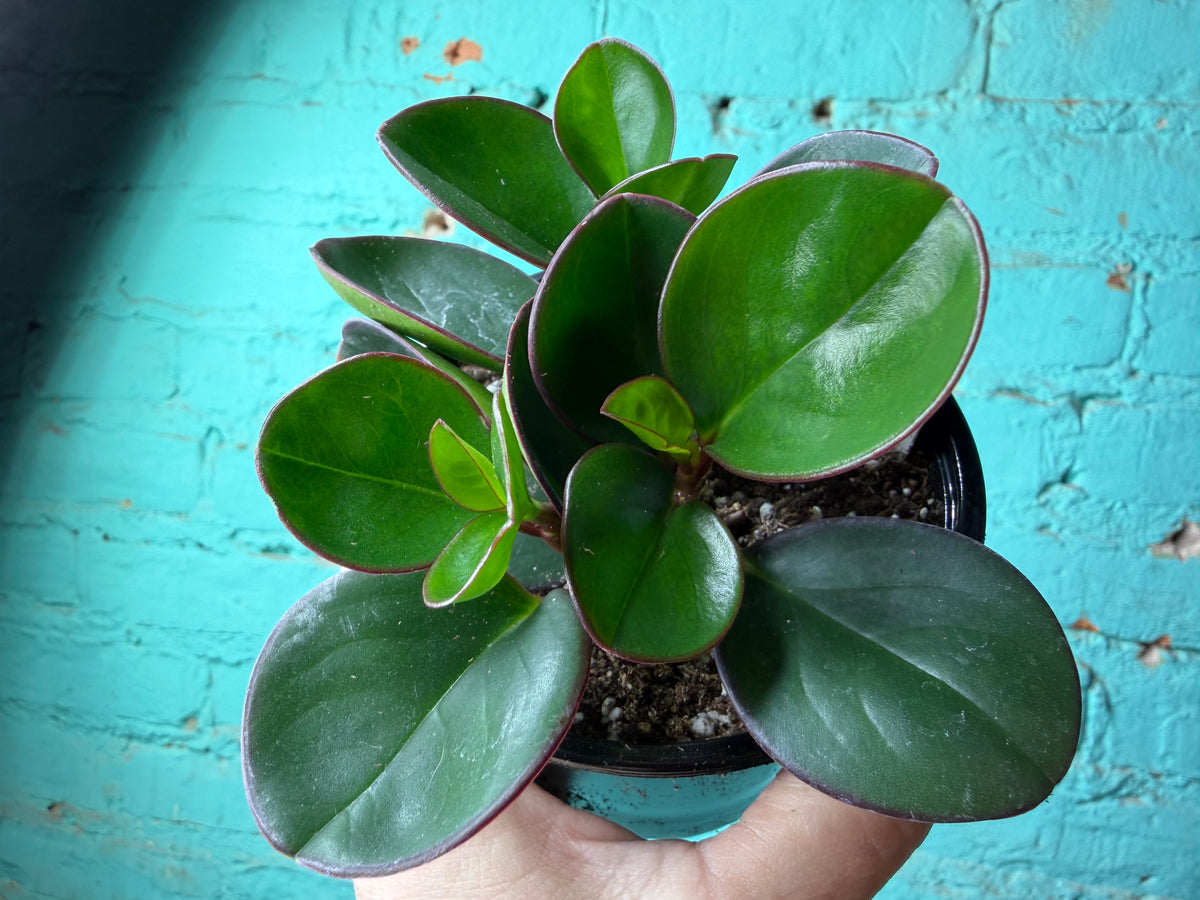
Each plant is unique. Size, shape, fullness, and variegation will vary.
Peperomia obtusifolia, commonly called Baby Rubber Plant, is a tropical species native to parts of the Americas and the Caribbean. It is grown for its thick, smooth, rounded green leaves and sturdy, fleshy stems. Those succulent-like leaves and stems store water, which is an important part of understanding how this plant grows and why it does not need to be treated like a tropical plant that wants a constantly wet root zone. Its simple glossy green foliage and naturally compact growth also make it an easy plant to fit into smaller spaces.
Peperomia obtusifolia is a compact, branching plant rather than a climber. It develops thicker stems as it matures and branches to create a fuller, upright to spreading shape. Older stems can eventually lean or spill slightly over the edge of the container, but the plant does not need a pole or other support. Its root system stays relatively small compared with the foliage above the pot, so a large plant does not automatically need a large container. Mature plants can also produce narrow upright flower spikes. They may look unusual if you have never seen a Peperomia flower before, but they are completely normal.
For natural light, start green Peperomia obtusifolia approximately 2–4 feet from an east-facing window or 3–5 feet from a west-facing window. Peperomia obtusifolia prefers approximately 300–800 foot-candles at the leaves. Foot-candles simply tell you how much light is actually reaching your plant. The solid-green form can make good use of somewhat lower light than a heavily variegated Peperomia, but useful light still matters if you want compact, steady growth rather than a plant that slowly stretches toward the window. Window direction and distance are starting points. Trees, overhangs, neighboring buildings, window size, season, screens and glass can all change how much light actually reaches the plant.
If you are using grow lights, choose a 5000–6500K light and aim for the same 300–800 foot-candles at the leaves. Kelvin tells you the color of the light, not how strong it is. Foot-candles tell you how much light is actually reaching the plant. There is no universal distance between a grow light and your Peperomia because fixtures produce very different amounts of light. Measure at the foliage and use that number to determine placement.
Water when your plant needs watered. Peperomia obtusifolia stores water in its thick leaves and stems and can comfortably allow its root zone to become drier between waterings than many tropical foliage plants. Let it use a substantial amount of the available moisture before watering thoroughly again. Its relatively small root system is much less forgiving of a dense mix that remains wet for long periods. Use a well-draining mix and keep the container reasonably matched to the root system rather than moving it into an oversized pot simply because the foliage has become larger.
Learn how the leaves feel when the plant is well hydrated. Healthy leaves are normally thick and firm. As the plant uses its stored moisture, they can begin to feel slightly less rigid, which is a good reason to check the root zone and see whether the plant is ready for water. If leaves become soft, yellow or begin declining while the pot is still wet, adding more water is not the answer. Check how long the root zone has been staying wet. Long stems with increasingly large spaces between the leaves are also a reason to check the amount of light reaching the plant.
Success looks like thick, firm green leaves, sturdy stems, active branching and relatively compact spacing between new leaves. As the plant matures, new branches should gradually create a fuller shape, and you may see its characteristic flower spikes during active growth. Don’t judge the health of the entire plant by an older leaf eventually declining. Watch the new growth. If it is continuing to branch and produce strong, well-formed foliage, the plant is moving in the right direction.