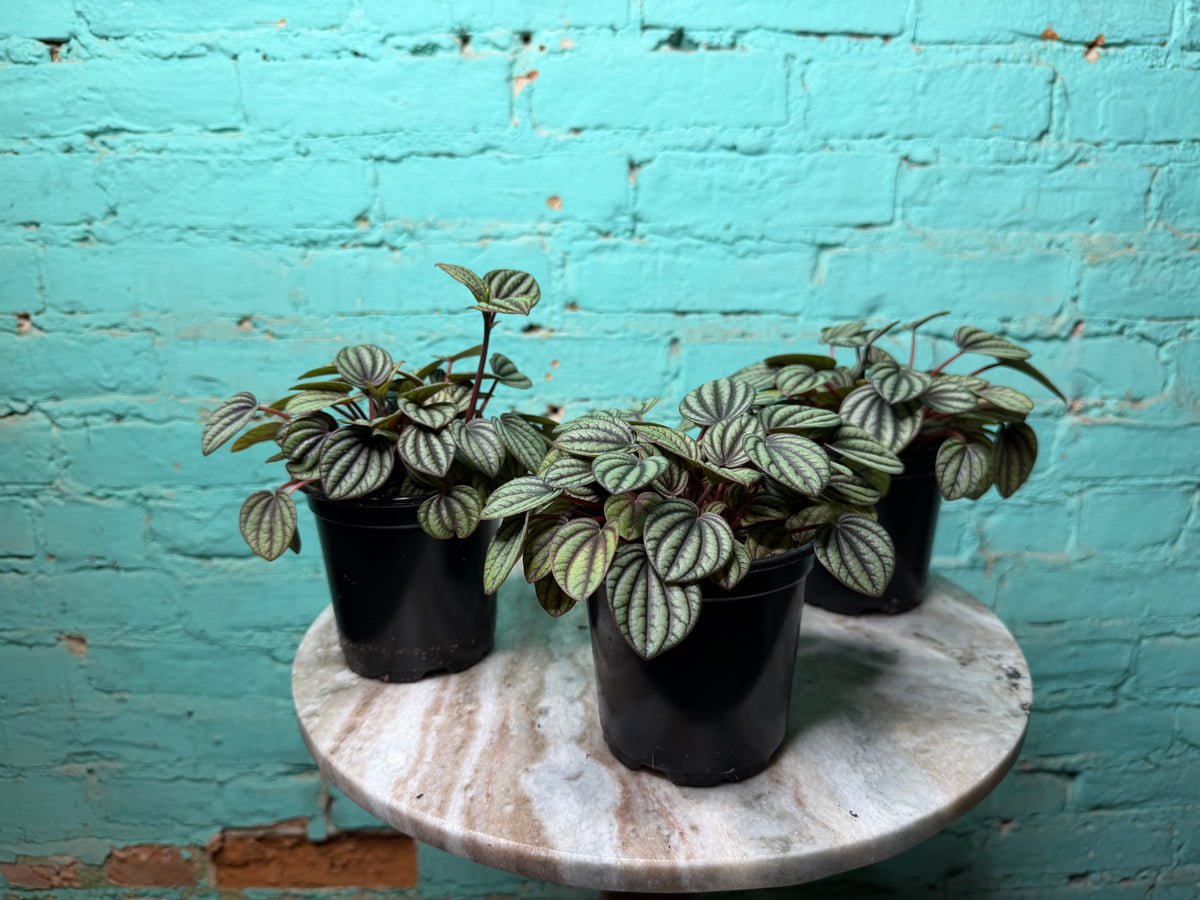
Each plant is unique. Size, shape, fullness, and variegation will vary.
Peperomia ‘Piccolo Banda’, Peperomia albovittata ‘Piccolo Banda’, is a compact Peperomia known for its deeply grooved leaves and dramatic dark venation. The species is native to Ecuador, while ‘Piccolo Banda’ itself was developed in the Netherlands from a cross between two Peperomia albovittata plants. The cultivar was selected for its smaller heart-shaped leaves and distinctive dark brown to burgundy veins against silvery to light green foliage. Reddish petioles add even more contrast and make this a beautiful little plant even before you notice all of the texture in the leaves.
Piccolo Banda grows as a compact rosette rather than a vine or trailing plant. New leaves emerge from short stems and gradually build a low, full mound of foliage. It stays relatively compact, making it a good choice when you want an interesting plant without eventually needing a large amount of growing space. Mature plants can reach roughly 10 inches across or more under good conditions, but the growth remains dense rather than tall. Like other Peperomia, it can also produce thin flower spikes extending above the foliage. They don’t look like traditional flowers, but they’re completely normal.
For natural light, start Piccolo Banda approximately 1–3 feet from an east-facing window or 1–3 feet from a north-facing window. Aim for approximately 400–800 foot-candles at the leaves as a practical indoor growing range. Foot-candles simply tell you how much light is actually reaching your plant. Enough useful light helps maintain compact growth and supports the contrast and pattern in the foliage without requiring the intense light we would give a succulent. Window direction and distance are starting points. Trees, overhangs, neighboring buildings, window size, season, screens and glass can all change how much light actually reaches the plant.
If you’re using grow lights, choose a 5000–6500K light and aim for the same approximately 400–800 foot-candles at the foliage. Kelvin tells you the color of the light, not its strength. Foot-candles tell you how much light is actually reaching the plant. There is no universal number of inches Piccolo Banda should sit beneath a grow light because different fixtures produce very different amounts of light. Measure at the leaves and adjust the plant or fixture based on what is actually reaching the canopy.
Water when your plant needs watered. Piccolo Banda has fleshy leaves and a relatively fine, fibrous root system, so it does not need to remain constantly wet. Allow the plant to use a good portion of the moisture in the root zone before thoroughly watering again. An airy, well-draining mix and a container reasonably matched to the root system make that moisture cycle much easier to manage. Avoid putting a small Peperomia into a large volume of dense soil that stays wet long after the plant has taken what it needs.
Read the leaves along with the root zone. Healthy foliage should feel firm and substantial. Leaves becoming noticeably softer or less firm can be a reason to check whether the plant is ready for water, but always check the root zone before deciding. If leaves or stems are becoming soft while the growing medium remains wet, investigate how long the roots have been sitting wet rather than automatically adding more water. If new growth begins stretching, leaning or becoming less compact, check how much useful light is actually reaching the plant.
Success looks like a dense rosette with sturdy petioles, firm leaves and new foliage continuing to develop that beautiful contrast between the lighter leaf surface and dark recessed veins. New leaves should gradually fill the plant from the center rather than becoming progressively stretched or widely spaced. And if those skinny Peperomia flower spikes begin popping up above the foliage, let them do their thing. They’re simply another part of how this Peperomia grows.