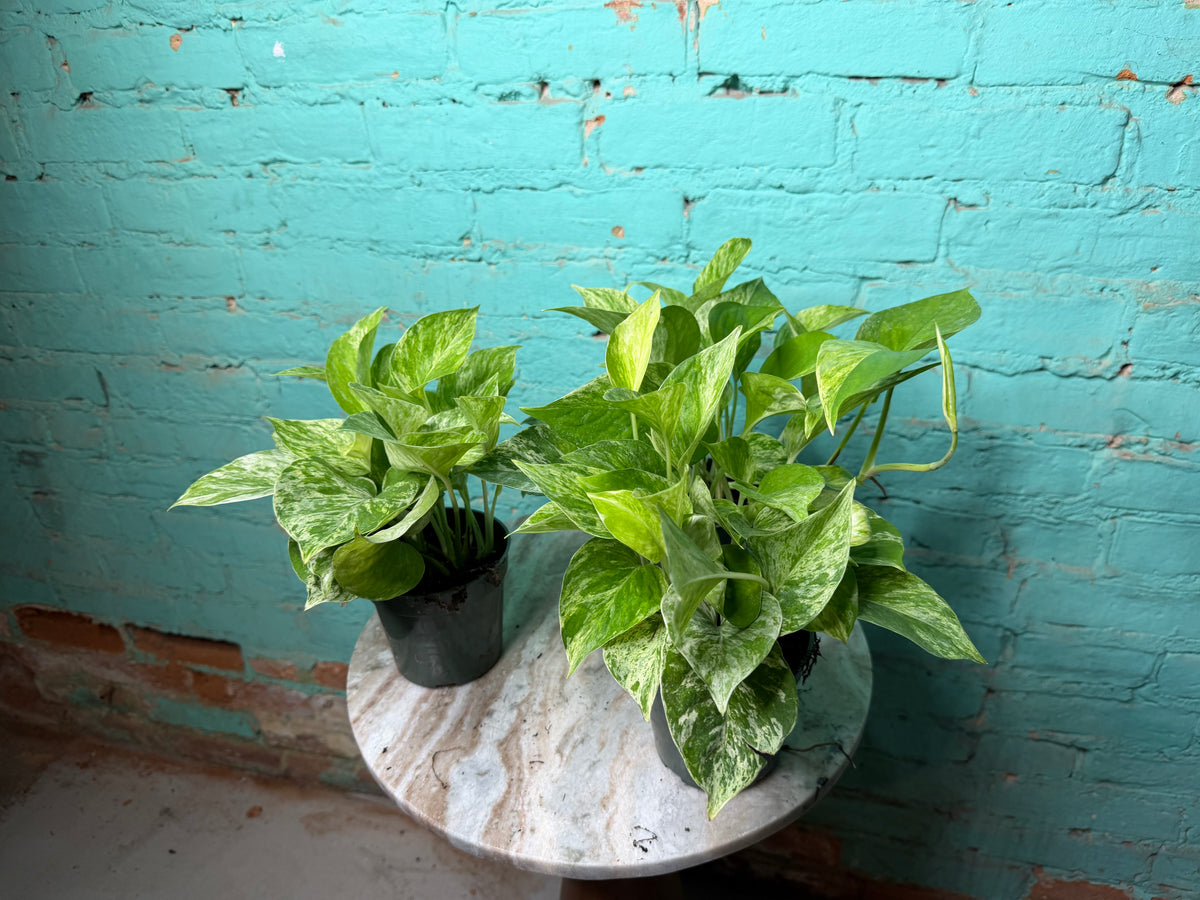
Each plant is unique. Size, shape, fullness, and variegation will vary.
Marble Queen Pothos, Epipremnum aureum ‘Marble Queen’, is a variegated form of pothos known for green leaves heavily marbled with cream and white. The pattern can vary considerably from leaf to leaf, with some emerging predominantly green and others carrying much more cream. It belongs to the same species as Golden Pothos, a tropical aroid native to the South Pacific. What makes Marble Queen stand apart is the amount of light-colored tissue across the foliage, giving an otherwise very adaptable plant a completely different appearance.
Pothos is naturally a climbing vine, even though we commonly grow it trailing from shelves and hanging baskets indoors. A young Marble Queen has relatively small leaves, but that is not necessarily its mature form. Given something to climb, its aerial roots can attach to the support and the leaves have the potential to become progressively larger as the vine matures. Mature Epipremnum aureum can eventually develop very large leaves with splits in tropical conditions, although reaching that stage indoors takes the right combination of maturity, useful light and vertical support. If you prefer a trailing plant, you can absolutely grow it that way. Just understand that climbing encourages a different type of growth than allowing the vines to continually trail.
For natural light, start Marble Queen approximately 1–3 feet from an east-facing window or 3–5 feet from a south-facing window. Marble Queen Pothos prefers approximately 500–1,000 foot-candles at the leaves. Foot-candles simply tell you how much light is actually reaching your plant. Marble Queen can tolerate lower light, but its heavily variegated leaves contain less green tissue than a Golden Pothos, so I would not intentionally put it in the lowest light a pothos can survive. Window direction and distance give you a starting point, but trees, overhangs, neighboring buildings, window size, season, screens and glass can all change how much light actually reaches the plant.
If you are using grow lights, choose a 5000–6500K light and aim for the same 500–1,000 foot-candles at the leaves. Kelvin tells you the color of the light, not how strong it is. Foot-candles tell you how much light is actually reaching the plant. There is no universal number of inches Marble Queen should sit beneath a grow light because every fixture produces a different amount of light. Measure at the foliage and adjust your placement from there. As the vines spread or the plant becomes larger, also pay attention to whether the fixture is covering the entire plant rather than only the leaves directly underneath it.
Water when your plant needs watered. Marble Queen Pothos can tolerate some drying between waterings, but that does not mean the root zone should repeatedly become extremely dry. Let the plant use a good portion of the available moisture, then water thoroughly and allow the excess to drain. A well-draining mix that holds some moisture while still allowing oxygen around the roots works well. How quickly that pot moves through water will change with light, temperature, root mass, plant size and season, so check the plant and the moisture deeper in the pot rather than assigning it a watering day.
Read the leaves, vines and root zone together. Leaves beginning to lose firmness or the plant becoming noticeably limp can be a reason to check whether it has become too dry, but don’t automatically water without checking the pot. Yellowing leaves can have several causes, including a root zone remaining wet too long, so one yellow leaf is not a diagnosis. Increasingly long spaces between leaves, smaller new foliage or vines reaching toward a light source are reasons to check whether the plant is receiving enough useful light. Variegation naturally changes from leaf to leaf, so don’t use one greener leaf as proof that something is wrong.
Success looks like steady vine growth, healthy roots and new leaves that continue developing with Marble Queen’s characteristic green-and-cream pattern. If you grow it on a support, progressively larger leaves and a vine that begins establishing itself vertically are excellent signs of progression. If you prefer it trailing, look for healthy branching and vines that continue producing well-spaced foliage rather than becoming increasingly sparse. You don’t need every leaf to have the same amount of white or every vine to look perfect. Watch the direction the plant is moving.