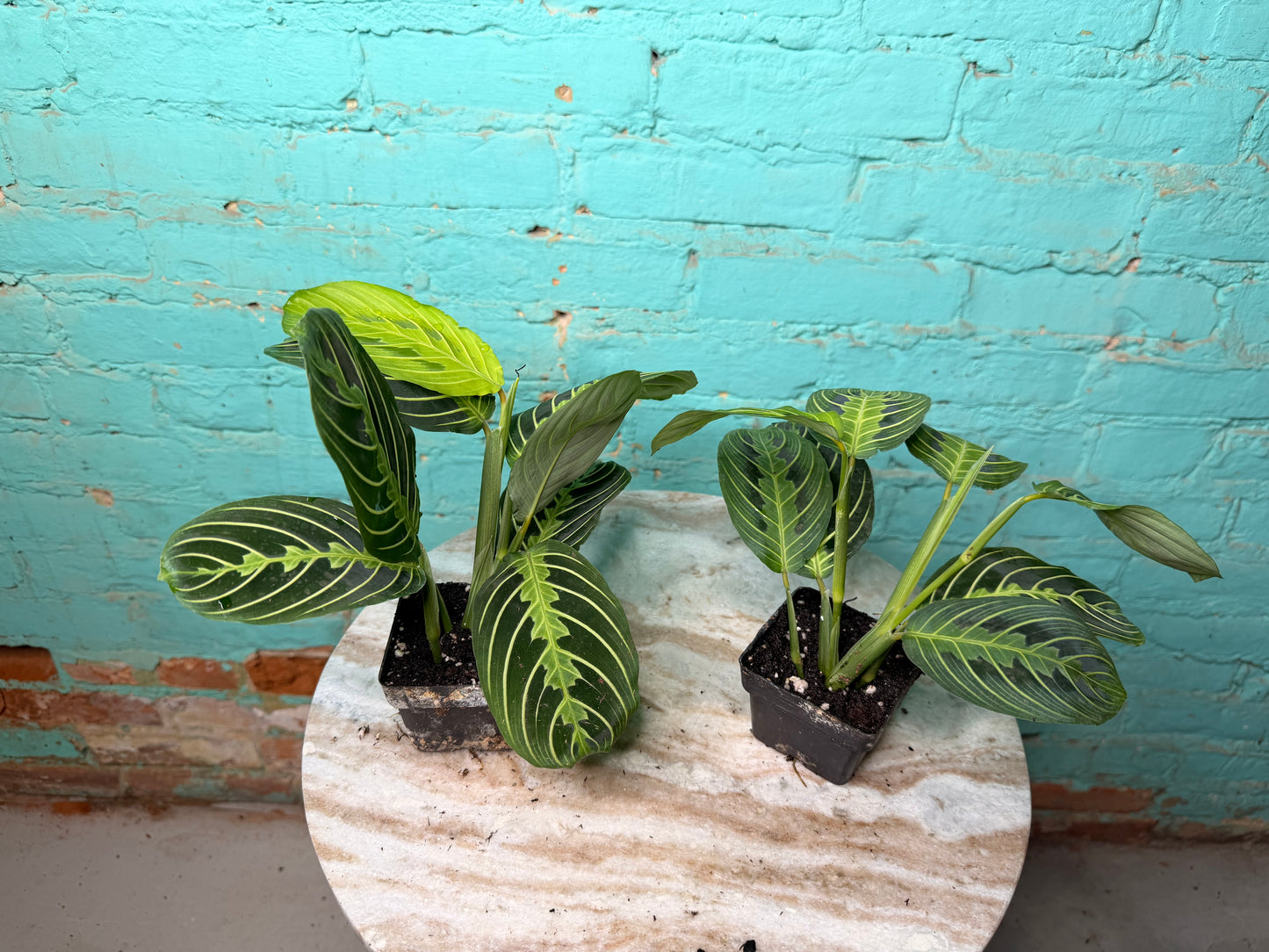
Each plant is unique. Size, shape, fullness, and variegation will vary.
Lemon Lime Prayer Plant |
Maranta leuconeura
‘Lemon Lime’
Lemon Lime Prayer Plant, Maranta leuconeura ‘Lemon Lime’, is a tropical prayer plant grown for its incredible patterned foliage. Instead of the red veins found on the classic Red Prayer Plant, Lemon Lime develops layers of dark green, medium green and bright lime-green markings that follow the veins and center of each leaf. It belongs to the Marantaceae, or prayer plant family, and its leaves naturally change position throughout the day, often lifting upward in the evening. That movement is normal and is part of what makes Maranta so interesting to grow.
Lemon Lime stays relatively low and spreads outward rather than becoming a tall upright plant. New leaves emerge tightly rolled before unfurling, while established stems can creep outward and eventually trail over the edge of the container. It does not need a pole or vertical support. As the plant develops, branching and new growth can create a wide, full plant with layers of patterned foliage.
For natural light, start Lemon Lime approximately 1–3 feet from an east-facing window or 1–3 feet from a north-facing window. Lemon Lime Prayer Plant prefers approximately 300–700 foot-candles at the leaves. Foot-candles simply tell you how much light is actually reaching your plant. Enough useful light supports healthy growth and strong foliage pattern without requiring the intensity we would give a succulent or high-light plant. Window direction and distance are starting points. Trees, overhangs, neighboring buildings, window size, season, screens and glass can all change how much light actually reaches the plant.
If you’re using grow lights, choose a 5000–6500K light and aim for the same approximately 300–700 foot-candles at the foliage. Kelvin tells you the color of the light, not its strength. Foot-candles tell you how much light is actually reaching the plant. There is no universal distance between Lemon Lime and a grow light because different fixtures produce very different amounts of light. Measure at the leaves and adjust based on what is actually reaching the canopy.
Water when your plant needs watered. Lemon Lime generally prefers a more even moisture cycle than plants that tolerate a substantial dryback. Let it use some of the available moisture before thoroughly watering again, but repeatedly allowing the entire root zone to become extremely dry can be hard on the foliage. Use an airy, well-draining mix that holds some moisture without remaining heavy and saturated. Marantas can also be sensitive to mineral and fertilizer salt buildup, so water quality is worth considering if browned or crispy leaf edges become a repeated pattern.
Read the leaves, but don’t use their normal daily movement as a watering signal. Leaves lifting in the evening and lowering again during the day are expected. Leaves that remain tightly curled, lose firmness or repeatedly develop crispy edges are reasons to check the root zone and overall environment rather than assuming one cause. Cold drafts, prolonged dryness and a root zone that remains wet for too long can all affect the foliage.
Success looks like steady new leaves emerging tightly rolled and then opening into full, strongly patterned foliage. Healthy stems should continue spreading and branching, gradually creating a fuller plant. An occasional older leaf or imperfect edge isn’t a reason to change everything you’re doing. Watch the newest growth. When Lemon Lime continues producing substantial leaves with strong green and lime patterning, the plant is moving in the right direction.