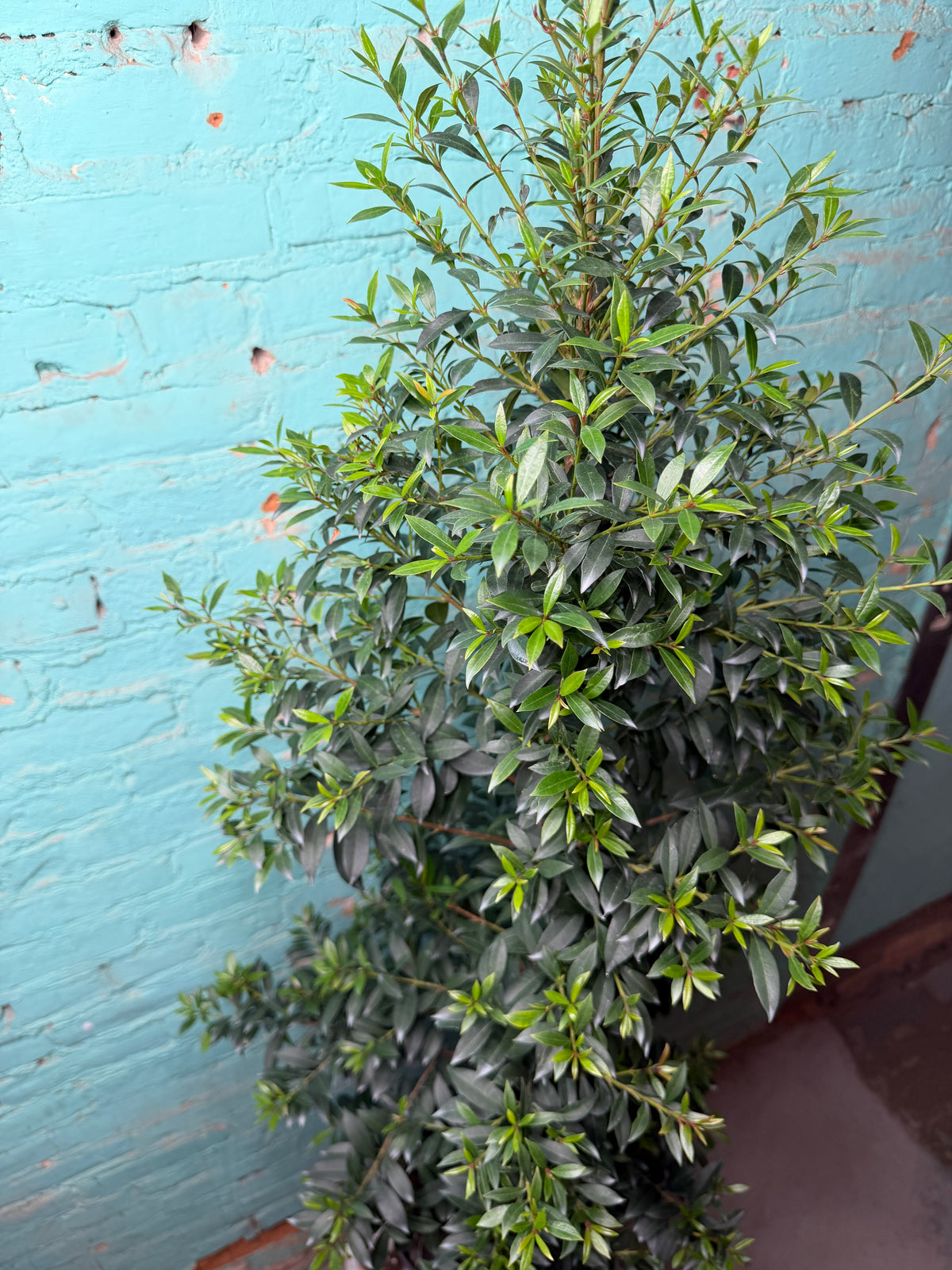
Each plant is unique. Size, shape, fullness, and variegation will vary.
Magenta Cherry, Syzygium paniculatum, also called Australian Brush Cherry, is an evergreen tree native to the coastal rainforests of eastern Australia. This is important to understand when buying one as a houseplant: it isn’t naturally a small foliage plant. In the wild it can become a substantial tree, while container growing and pruning keep it much smaller indoors. It develops glossy green leaves, colorful bronze to reddish new growth, fluffy white flowers and, on mature flowering plants, edible magenta to reddish-purple fruit. Its naturally dense branching and willingness to tolerate pruning are also why it is frequently grown as a bonsai.
Magenta Cherry grows upright with woody stems and becomes increasingly tree-like as it matures. Indoors, regular pruning can maintain a compact canopy and encourage branching rather than allowing a few stems to simply continue upward. How large you allow it to become will depend heavily on container size, available light and pruning. This is a plant you can shape over time, whether you want a fuller shrub-like specimen or a small indoor tree.
For natural light, give Magenta Cherry one of your strongest windows. Start it directly in a south-facing window or within approximately 1 foot of a west-facing window. Aim for approximately 2,000–4,000 foot-candles at the leaves indoors. Foot-candles simply tell you how much light is actually reaching your plant. This is a high-light tree, and putting it several feet into a room because it is labeled a houseplant will not provide the same environment as growing directly at a strong window. Window direction and distance are starting points. Trees, overhangs, neighboring buildings, window size, season, screens and glass can dramatically change how much light actually reaches the plant.
If you’re using grow lights, choose a 5000–6500K light and aim for the same approximately 2,000–4,000 foot-candles at the canopy. Kelvin tells you the color of the light, not its strength. Foot-candles tell you how much light is actually reaching the plant. There is no universal distance between Magenta Cherry and a grow light because fixtures vary tremendously in output. Also consider coverage. As this plant develops a wider canopy, a small fixture may adequately light the center while leaving much of the outer foliage with considerably less useful light.
Water when your plant needs watered. Unlike a succulent, Magenta Cherry should not be repeatedly taken through extreme dry periods. Let the root zone use moisture and experience some dryback, then water thoroughly and allow excess water to drain. An airy, well-draining mix helps maintain both moisture and oxygen around the roots. A larger, actively growing tree in strong light can use considerably more water than a recently purchased plant, so allow the plant and root zone to tell you when it’s ready rather than putting it on a schedule.
Pay attention to the newest growth and the density of the canopy. Strong new shoots with leaves developing relatively close together are good signs. Increasingly thin, stretched growth, larger spaces between leaves or significant leaning toward a window are reasons to measure how much light is actually reaching the canopy. Repeatedly allowing the root zone to become extremely dry can also lead to leaf loss, while declining growth in a pot that remains wet for long periods should make you investigate drainage and the root zone rather than automatically adding more water.
Success looks like dense branching, glossy foliage and steady new growth that develops into increasingly woody stems. New leaves may emerge with bronze or reddish tones before becoming greener as they mature. With maturity and enough light, the plant is also capable of producing its characteristic white flowers followed by colorful fruit. If you’re growing it primarily for its foliage and tree form, flowering isn’t required to call it successful. Watch the direction of the new growth: a dense, sturdy canopy is telling you far more about the plant’s environment than expecting every individual leaf to remain perfect.