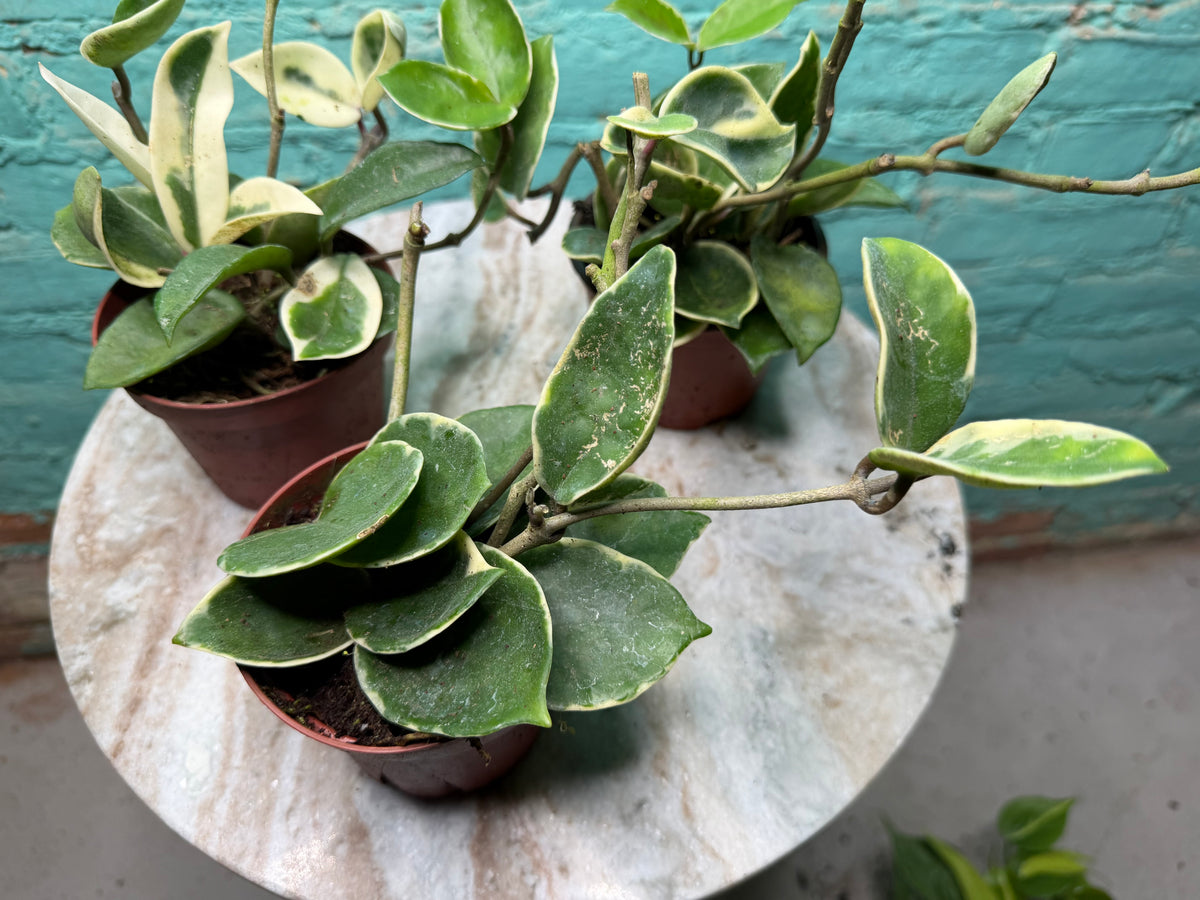
Each plant is unique. Size, shape, fullness, and variegation will vary.
Hoya Carnosa Albo (Wax Plant) is a variegated version of Carnosa. A tropical and subtropical species native across parts of eastern Asia and the western Pacific. Its thick, waxy leaves combine green with irregular cream-to-white variegation, often concentrated along the outer portions of the leaf. New growth can also emerge with pink or reddish tones before hardening into its mature coloring. Because Hoya naming in the trade can be inconsistent, “Albo” is best used descriptively here rather than assigning an unverified cultivar history to the plant.
Hoya carnosa is a vining and climbing plant with long, flexible stems. You can allow the vines to trail, but they naturally climb and wrap around available support, making a trellis a good option if you want a more upright plant. Don’t be concerned when a long bare vine appears before it produces leaves. Hoyas commonly send out exploratory vines that later develop foliage. Mature plants can also produce clusters of fragrant, star-shaped flowers from persistent flowering structures called peduncles. Leave those peduncles attached after flowering because the plant can bloom from them again.
For natural light, start Hoya carnosa Albo approximately 1–2 feet from an east-facing window or 1–3 feet from a west-facing window. Hoya carnosa Albo prefers approximately 1,000–2,000 foot-candles at the leaves. Foot-candles simply tell you how much light is actually reaching your plant. The cream and white portions contain less chlorophyll than the green tissue, so useful light is particularly important for supporting strong growth. More light does not create the variegation, however, and a plant moving into substantially stronger light should be acclimated rather than abruptly relocated.
If you’re using grow lights, choose a 5000–6500K fixture and aim for the same approximately 1,000–2,000 foot-candles at the foliage. Kelvin tells you the color of the light, not its strength. Foot-candles tell you how much light is actually reaching the plant. There is no universal distance between a Hoya and its grow light because fixtures vary considerably in output and coverage. Measure at the leaves, and remember that a long vine may receive very different amounts of light from one end to the other.
Water when your plant needs watered. Hoya carnosa has thick leaves that store water and generally does well with a substantial dryback between thorough waterings. Its roots still need both water and oxygen, so use an airy, fast-draining mix rather than keeping the root zone continuously wet. Avoid automatically increasing pot size simply because the vines have become long. The amount of foliage above the pot doesn’t necessarily tell you how much root mass is inside it.
Read the leaves, vines and newest growth together. Firm, substantial leaves are useful indicators of hydration, while leaves becoming less rigid can be one clue that the plant has used more of its available water. Long new vines aren’t automatically a sign that the plant needs more light, especially when they are fresh exploratory growth. Instead, watch what happens as those vines develop. Progressively weak growth, very long spacing between established leaves or increasingly small foliage are better reasons to evaluate the amount of useful light reaching the plant.
Success looks like sturdy vines producing firm, well-spaced leaves with continued green and cream variegation. An established plant may eventually send out multiple vines and produce clusters of fragrant flowers, but flowering isn’t the only measure of a healthy Hoya. Watch the newest growth, root-zone behavior and overall direction of the plant. When new vines continue developing into healthy foliage and the plant steadily builds its structure, your Hoya is moving in the right direction