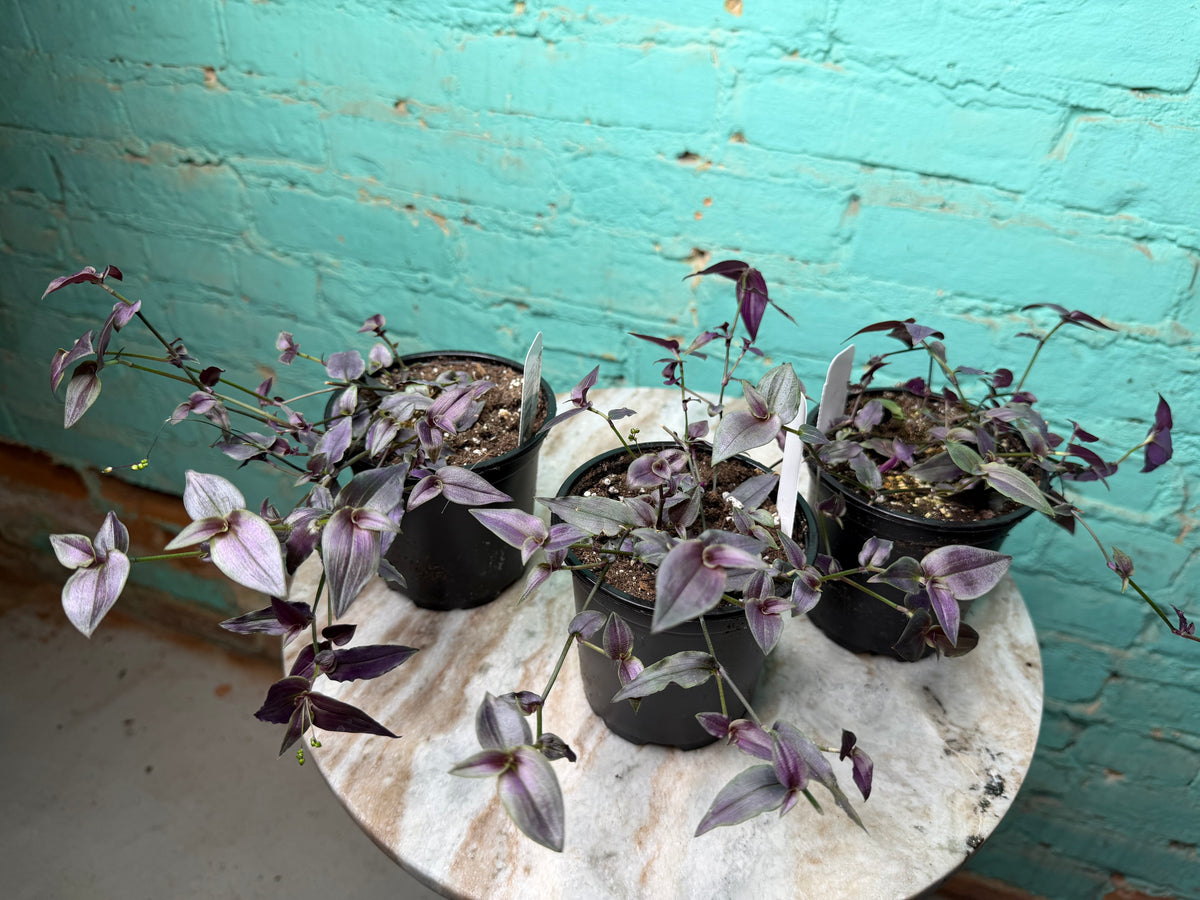
Each plant is unique. Size, shape, fullness, and variegation will vary.
Tahitian Bridal Veil, Gibasis pellucida, is a delicate trailing plant in the same family as Tradescantia. It is often sold under the common name Bridal Veil and sometimes labeled as a Tradescantia, but Gibasis is its own genus. It develops small green leaves, often with a deeper purple tone underneath, along thin branching stems. Tiny white three-petaled flowers appear throughout the foliage, creating the scattered veil-like look behind its common name. It is native to Mexico and is especially beautiful in a hanging basket where the fine stems and flowers can spill freely around the pot.
Bridal Veil naturally develops long, branching stems rather than staying upright. As those stems grow, they trail over the edge of the container and create a much fuller plant than the small starter you may be purchasing today. It does not need a pole or other vertical support. Regular trimming can encourage additional branching if you want a dense, rounded basket rather than a few very long stems. Those cuttings can also root readily, which makes it relatively easy to add fullness back into the same pot as the plant grows.
For natural light, start Bridal Veil approximately 1–3 feet from an west-facing window or 3–5 feet from a south-facing window. Tahitian Bridal Veil prefers approximately 500–1,000 foot-candles at the leaves. Foot-candles simply tell you how much light is actually reaching your plant. Useful light helps support tighter, fuller growth and flowering rather than long, sparse stems. Window direction and distance are starting points. Trees, overhangs, neighboring buildings, window size, season, screens and glass can all change how much light actually reaches the plant.
If you are using grow lights, choose a 5000–6500K light and aim for the same 500–1,000 foot-candles at the foliage. Kelvin tells you the color of the light, not how strong it is. Foot-candles tell you how much light is actually reaching the plant. There is no universal distance Bridal Veil should sit beneath a grow light because fixtures vary considerably in output. With a wide hanging basket, coverage matters too. Make sure useful light is reaching more than just the small area directly beneath the center of the fixture.
Water when your plant needs watered. Bridal Veil has a relatively fine root system and generally does best when it does not swing repeatedly between staying saturated and becoming extremely dry. Let the plant use a good portion of the available moisture before watering thoroughly again, and use a well-draining mix that allows both water and air to move through the root zone. Hanging baskets can dry differently from pots sitting on a shelf, especially as the plant becomes larger, so check the actual moisture in the pot instead of assuming it needs water because a certain number of days have passed.
Read the stems and foliage along with the root zone. A plant that begins looking limp or losing its usual firmness is a reason to check whether it has become too dry, while yellowing or declining growth should make you investigate whether the root zone has been staying wet too long. Long spaces between leaves, sparse growth and reduced flowering are reasons to check the amount of light reaching the plant. Older stems can also become less attractive over time. Trimming them and allowing newer growth to fill the basket is a normal part of maintaining a dense Bridal Veil rather than a sign that the plant has failed.
Success looks like active branching, closely spaced healthy foliage, stems steadily filling and spilling over the container, and those tiny white flowers appearing throughout the plant when conditions support blooming. Watch the overall fullness of the basket and the quality of its new growth. Bridal Veil does not need every stem to remain perfect forever. New branching, healthy foliage and continued flowering tell you the plant is moving in the right direction.