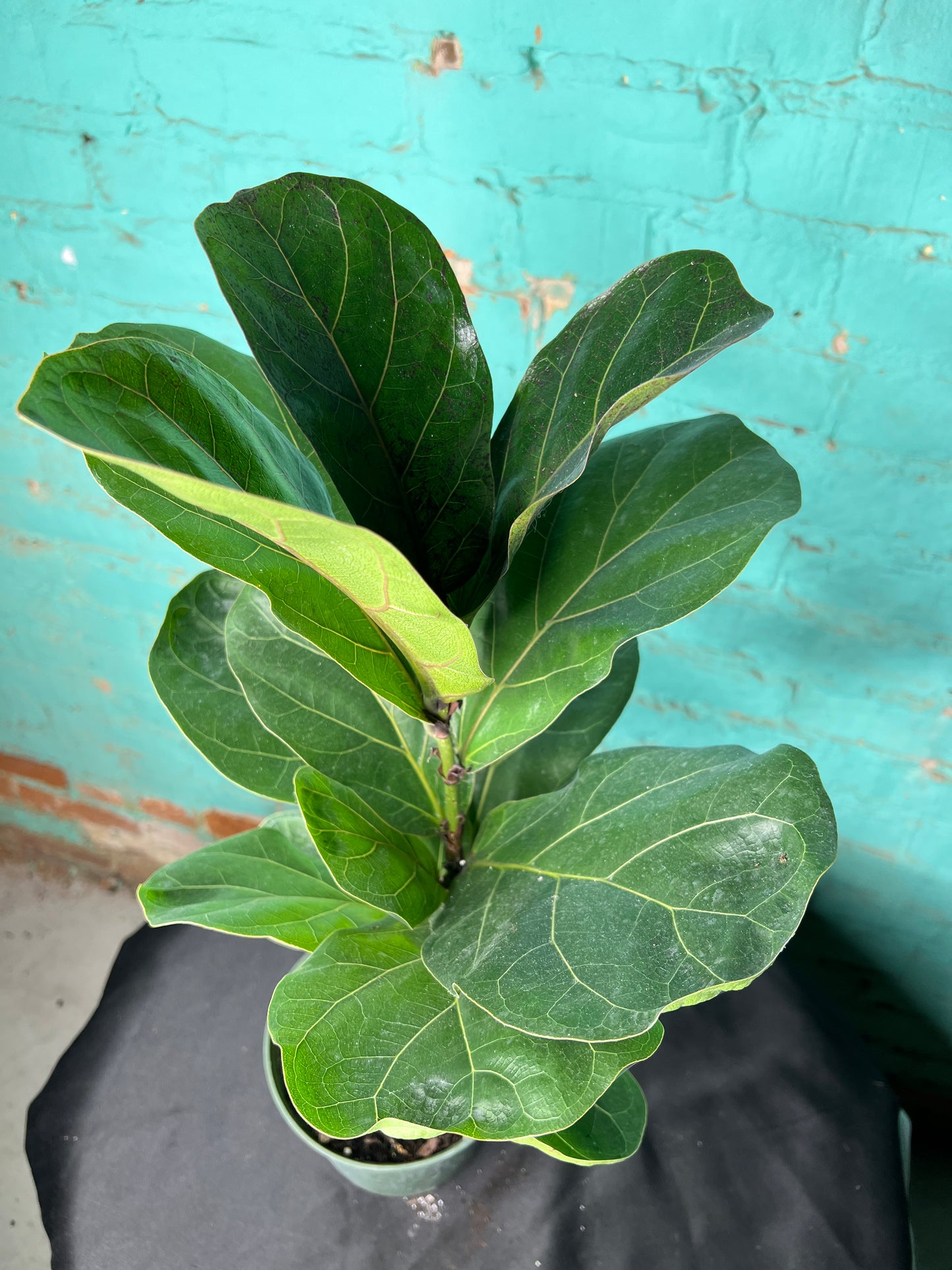
Each plant is unique. Size, shape, fullness, and variegation will vary.
Fiddle Leaf Fig |
Ficus lyrata
Fiddle Leaf Fig, Ficus lyrata, is a tropical evergreen tree native to western and central Africa. It is known for its large, thick leaves with prominent veins and the broad, slightly wavy shape that gives the plant its name. In its natural environment it becomes a substantial tree, while indoors it is commonly maintained around 2–10 feet tall through container growing and pruning. Its combination of large foliage and an upright woody trunk gives it the look of an indoor tree rather than a typical houseplant.
Fiddle Leaf Fig naturally wants to grow upright and woody. Young plants may begin as a single stem, while older plants can branch and develop a broader canopy. It does not need a pole or climbing support. Pruning can be used to control height and encourage branching, but it isn’t necessary simply because the plant has reached a certain size. New leaves develop near the growing tips, and under supportive conditions they should continue emerging large and substantial rather than becoming progressively smaller.
Light is especially important with Fiddle Leaf Fig. Start it directly in a south-facing window or approximately 1–2 feet from a west-facing window. Fiddle Leaf Fig prefers approximately 1,500–3,000 foot-candles at the leaves. Foot-candles simply tell you how much light is actually reaching your plant. This is a tree that can grow in very strong light, but plants grown indoors should be acclimated gradually when moving into substantially stronger conditions. Window direction and distance are starting points. Trees, overhangs, neighboring buildings, window size, screens, glass and seasonal changes can dramatically change the amount of light reaching the foliage.
If you’re growing it under lights, choose a 5000–6500K grow light and aim for the same approximately 1,500–3,000 foot-candles at the foliage. Kelvin tells you the color of the light, not its strength. Foot-candles tell you how much light is actually reaching the plant. Because Fiddle Leaf Figs can become tall, pay attention to coverage as well as intensity. A fixture that adequately lights the top few leaves may not provide enough light across the entire canopy. There is no universal number of inches the fixture should be from the plant. Measure at the leaves and adjust from there.
Water when your plant needs watered. Let the root zone use a good portion of its available moisture before watering thoroughly again, but don’t repeatedly take the entire root ball to an extreme dry point. How quickly that happens will change considerably with light, temperature, plant size, root development and season. Use a well-draining mix and a container that allows excess water to leave the root zone. Fiddle Leaf Figs can react to both prolonged saturation and repeated severe drying, which is why checking the plant and root zone is more useful than following a weekly schedule.
Read the newest growth and the overall tree. Increasingly smaller leaves, long spaces between leaves, leaning toward the window or slowed growth during the active season are reasons to investigate the amount of light reaching the plant. Leaf drop is a signal to look at the entire environment rather than immediately assuming the plant needs more or less water. Ficus can also respond to abrupt environmental changes, particularly major changes in light, so acclimation matters when bringing a greenhouse-grown plant home or moving it to a substantially different location.
Success looks like a sturdy upright tree with firm, substantial foliage, relatively compact spacing between leaves and new growth that continues developing at a healthy size. As the plant matures, the trunk becomes woodier and the canopy can become fuller through natural growth or intentional pruning. Fiddle Leaf Figs have a reputation for being difficult, but much of their care comes back to the same fundamentals: give the tree enough usable light, allow the root zone to move through a healthy wet-to-dry cycle, and watch what the newest growth is telling you.