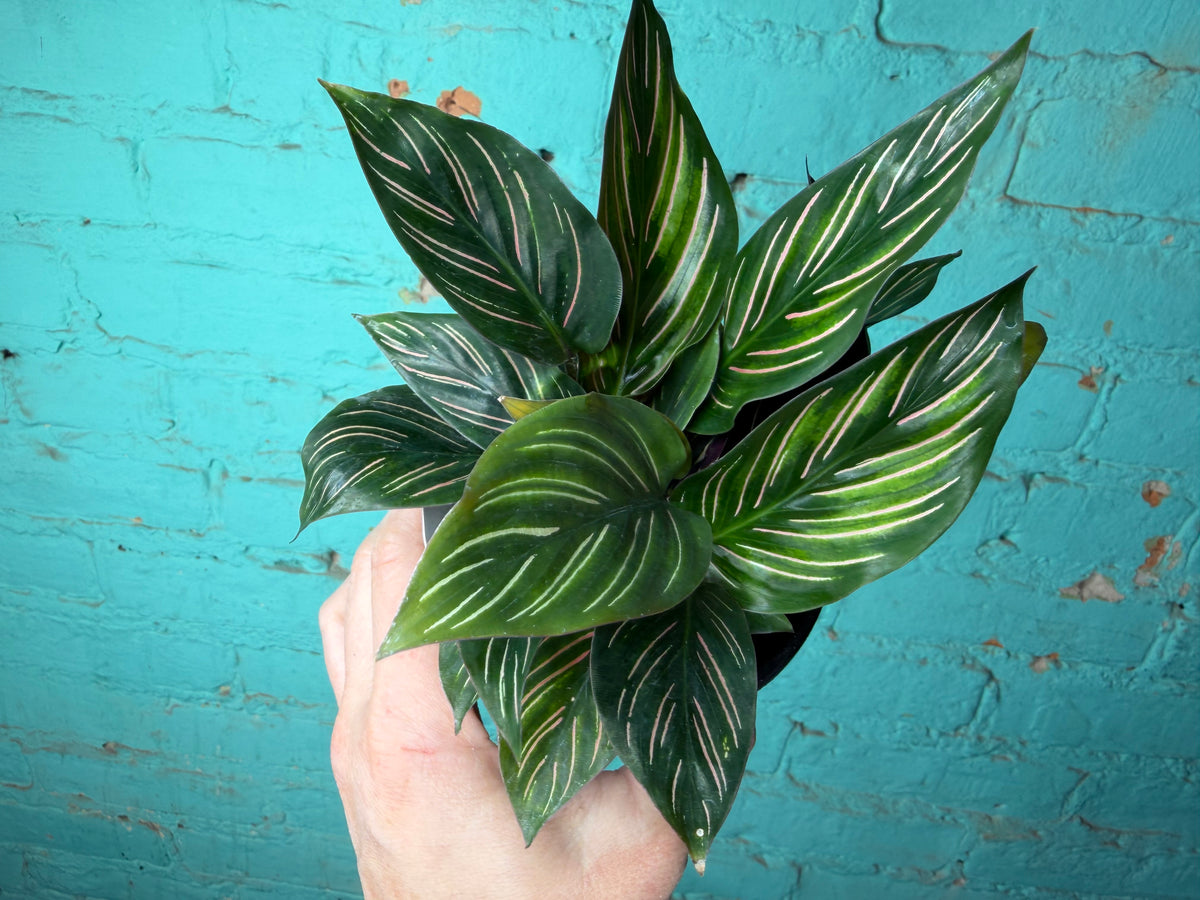
Each plant is unique. Size, shape, fullness, and variegation will vary.
Calathea Ornata, commonly called Pinstripe Calathea, is now botanically classified as Goeppertia ornata, although Calathea is still the name most people recognize. It is native to Colombia and Venezuela, where it grows as a tropical forest plant. The foliage is what makes this plant stand out. Dark green leaves are marked with fine pink to pale stripes that look almost hand-painted across the surface, while the undersides develop rich purple tones. New leaves may show brighter pink striping that softens as the foliage matures.
This is not a climbing or trailing plant. Calathea Ornata grows from the base, with new leaves emerging on individual stems from the root system below the soil. As it matures, additional growth fills the pot and creates a fuller, upright plant rather than producing vines that need support. It also belongs to the prayer plant family, Marantaceae. The leaves naturally change position throughout the day in response to light and the plant’s internal day-night rhythm, so seeing the foliage lift, lower or reposition itself is normal behavior.
For natural light, start Calathea Ornata approximately 2–4 feet from an east-facing window or 1–3 feet from a north-facing window. Calathea Ornata prefers approximately 300–700 foot-candles at the leaves. Foot-candles simply tell you how much light is actually reaching your plant. This is a plant adapted to growing beneath other vegetation, so it does not need the stronger light we would choose for many climbing aroids or highly variegated plants. Window direction and distance are starting points. Trees, overhangs, neighboring buildings, window size, season, screens and glass can all change how much light actually reaches the plant.
If you are using grow lights, choose a 5000–6500K light and aim for the same 300–700 foot-candles at the leaves. Kelvin tells you the color of the light, not how strong it is. Foot-candles tell you how much light is actually reaching the plant. There is no universal distance between the grow light and your Calathea because every fixture produces a different amount of light. Measure at the foliage and use that number to determine placement.
Water when your plant needs watered. Calathea Ornata generally prefers a more even moisture cycle than plants that are comfortable becoming quite dry between waterings, but that does not mean keeping the pot continuously saturated. Let it use some of the available moisture while avoiding repeated extremes of completely dry followed by soaking wet. A mix that holds some moisture while still allowing oxygen through the root zone works well. This is also a plant where water quality can matter. If you repeatedly see dry or browned leaf margins even though the root zone and environment seem appropriate, mineral or salt buildup from water or fertilizer is something worth considering.
Read the leaves, but remember that movement is normal for this plant. Leaves changing position between day and night are not the same thing as a plant collapsing from thirst. If the entire plant loses its usual firmness, check the moisture deeper in the pot before deciding it needs water. Crispy margins can make you investigate how dry the root zone has been getting, humidity, water quality or fertilizer buildup rather than automatically assuming there is one cause. Faded foliage or damaged areas can also be a reason to check whether the plant is receiving more light than it needs. One imperfect leaf does not diagnose the problem. Look at what has changed and what the newer growth is doing.
Success looks like new leaves continuing to emerge from the base, foliage maintaining its strong pattern and color, and the plant gradually becoming fuller as additional growth develops. New leaves often emerge tightly rolled and then unfurl into their full shape. Don’t expect every older leaf to remain flawless forever. If the plant continues producing healthy new foliage and filling its pot, that progression tells you much more about how it is doing than one brown edge or an older declining leaf.
Calatheas are worth routinely inspecting for spider mites. Their broad foliage gives you plenty of surface area to check, so make a habit of looking closely along the undersides of the leaves, around the midrib and where the leaf meets its stem. Speckling, discoloration or a declining leaf does not automatically mean spider mites. Damage is a reason to inspect, not an identification. Find the pest before deciding what treatment is needed.