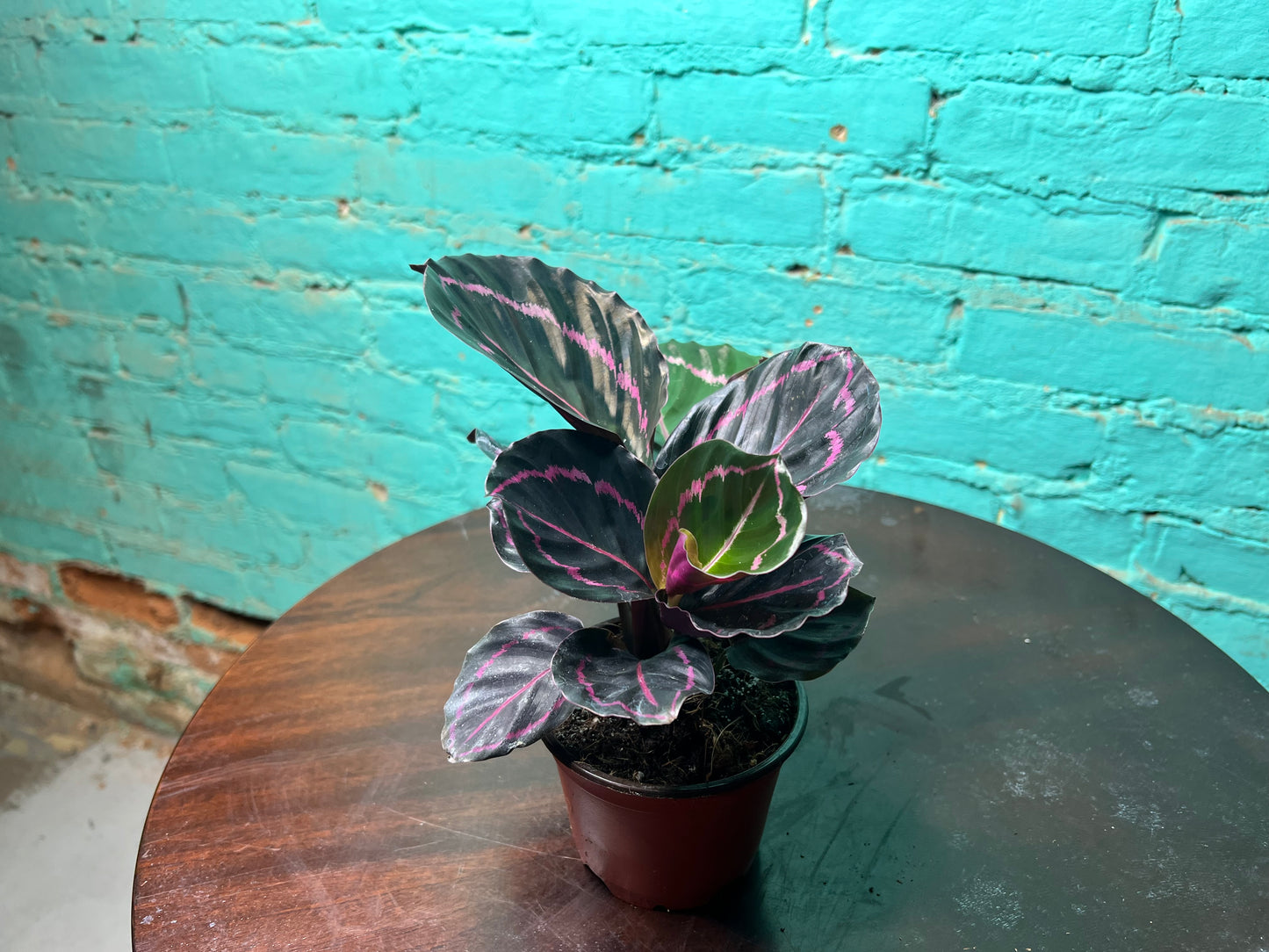
Each plant is unique. Size, shape, fullness, and variegation will vary.
Calathea ‘Dottie’, now botanically classified as Goeppertia roseopicta ‘Dottie’, is a dramatic member of the prayer plant family. Its nearly black, deep green leaves are marked by vivid pink lines that trace the inside edge of each leaf and run through the center, while the undersides develop rich purple tones. ‘Dottie’ is a cultivar of Goeppertia roseopicta, a South American species, and its unusually dark foliage makes it look completely different from many of the lighter green prayer plants.
Dottie grows as a compact clump rather than a vine or climbing plant. New leaves emerge tightly rolled before opening above the base of the plant, and established plants gradually become wider and fuller as new growth develops from below. It does not need a pole or support. Like other members of the prayer plant family, its leaves naturally change position throughout the day and often lift upward in the evening. That movement is normal and isn’t the plant wilting or asking for water.
For natural light, start Dottie approximately 1–3 feet from an east-facing window or 1–3 feet from a north-facing window. Dottie prefers approximately 300–700 foot-candles at the leaves. Foot-candles simply tell you how much light is actually reaching your plant. It needs enough useful light to support steady, compact growth, but it does not need the intensity we would give a succulent or high-light tree. Window direction and distance are starting points. Trees, overhangs, neighboring buildings, window size, season, screens and glass can all change how much light actually reaches the plant.
If you’re using grow lights, choose a 5000–6500K light and aim for the same approximately 300–700 foot-candles at the foliage. Kelvin tells you the color of the light, not its strength. Foot-candles tell you how much light is actually reaching the plant. There is no universal distance between Dottie and a grow light because different fixtures produce very different amounts of light. Measure at the leaves and adjust the plant or fixture based on what is actually reaching the canopy.
Water when your plant needs watered. Dottie generally prefers a more even moisture cycle and should not be treated like a plant that wants a substantial dryback. Let it use some of the available moisture before watering thoroughly again, but repeatedly allowing the entire root zone to become extremely dry can be hard on the foliage. Use an airy, well-draining mix that can retain some moisture without remaining heavy and saturated. Water quality and fertilizer buildup can also matter with this group, especially if browned or crispy leaf margins become a repeated pattern.
Read the leaves, but don’t mistake normal prayer plant movement for a watering signal. Leaves lifting and lowering between day and night are expected. Leaves that remain tightly curled, lose firmness or repeatedly develop crispy margins are reasons to check the root zone and overall environment. Also pay attention to temperature and drafts. This is a tropical plant that prefers a warm, relatively stable environment rather than repeated exposure to cold air.
Success looks like a full clump with firm foliage, steady new leaves emerging from the base and strong contrast between the nearly black-green leaves and their pink markings. New leaves should continue unfurling at a healthy size rather than becoming progressively smaller or weaker. Older leaves will eventually age and an imperfect edge doesn’t mean the entire plant is failing. Watch the direction of the newest growth. When Dottie continues producing substantial, richly patterned leaves, the plant is moving in the right direction.