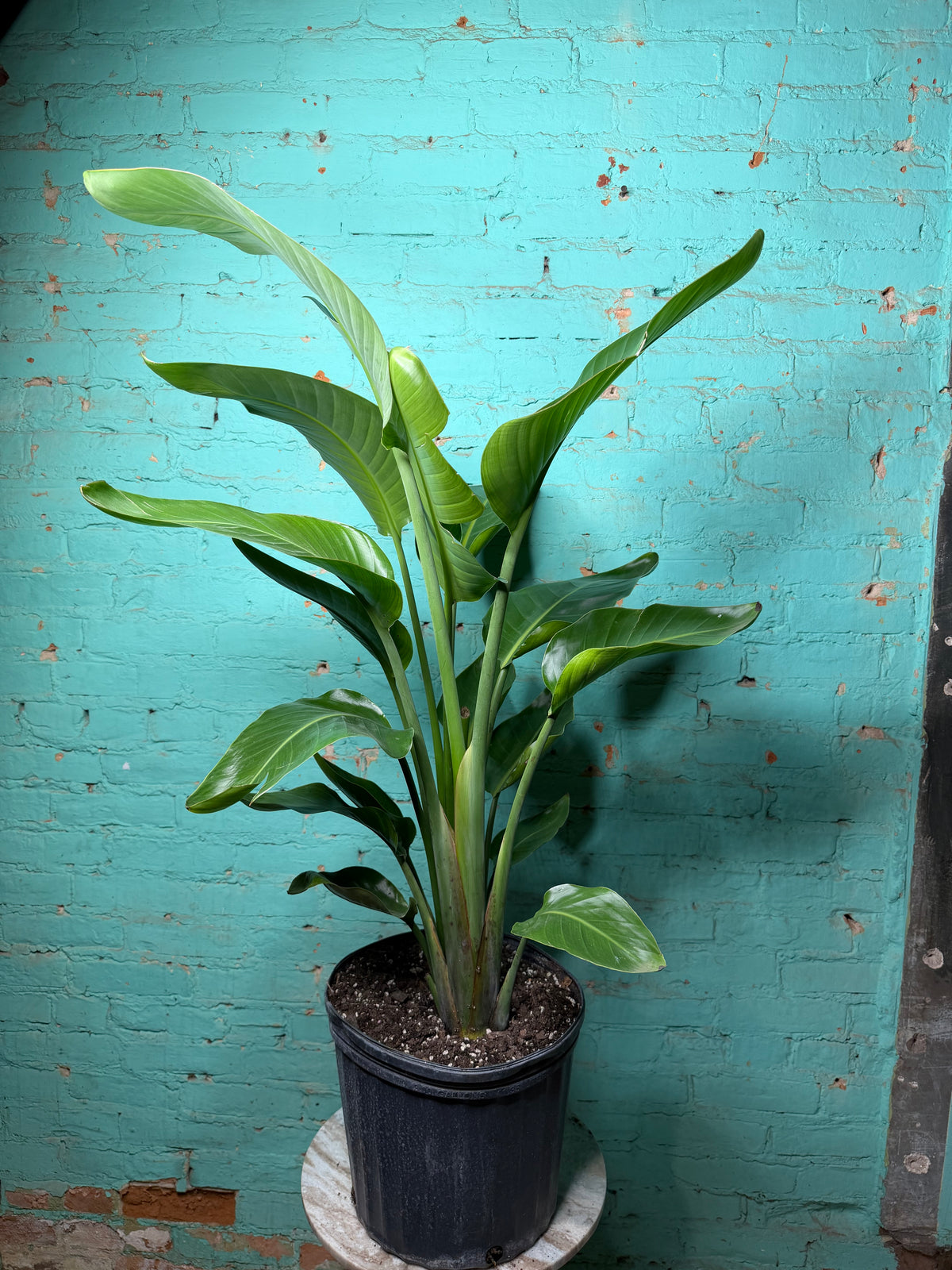
Each plant is unique. Size, shape, fullness, and variegation will vary.
Huge paddle-shaped leaves and an increasingly architectural, tree-like growth habit make this the much larger Bird of Paradise. Native to southern Africa, mature plants can produce white-and-blue flowers from dark, beak-shaped structures, but indoors this species is primarily grown for its dramatic foliage. Given enough time and space, it develops the enormous tropical canopy that makes White Bird of Paradise such a statement plant.
Young plants look considerably different from mature specimens. They begin with upright fans of narrower foliage, but each stage of maturity can bring progressively larger and broader leaves held on increasingly substantial stalks. Over time, the bases of older leaves contribute to thick, trunk-like stems and additional shoots can develop from the rhizome. In its native environment this species can become a tree-sized plant reaching approximately 25–40 feet tall. A container restricts that potential indoors, but this is still a genuinely large plant that can eventually require considerable vertical and horizontal space.
For natural light indoors, place it directly in a south-facing window or directly in a west-facing window. It prefers approximately 2,000–4,000 foot-candles at the leaves. Foot-candles simply tell you how much light is actually reaching your plant. Strong usable light supports the substantial foliage and robust growth this species is capable of producing. If successive leaves become smaller, petioles become increasingly stretched or the plant begins reaching strongly toward the window, check how much light is actually reaching the foliage. Gradually acclimate plants that have been growing in significantly lower light before exposing them to much stronger direct sun.
Under a grow light, use a full-spectrum 5000–6500K fixture positioned approximately 8–12 inches above the canopy, aiming for the same 2,000–4,000 foot-candles at the leaves. Kelvin describes the color of the light, while foot-candles tell you how much light is actually reaching the plant. Coverage becomes increasingly important as this species matures because the canopy can become very broad. Position the fixture so useful light reaches the developing foliage rather than concentrating only on one tall leaf.
Water when your plant needs watered. During active growth in strong light, a large plant can use a considerable amount of moisture through its extensive foliage. Allow it to use a good portion of the available moisture before watering thoroughly again rather than keeping the root zone continuously saturated. Its substantial roots and rhizomes need both moisture and oxygen, so use a well-draining mix that retains some moisture while allowing excess water to move through the pot. Pot size, root mass, temperature and light can dramatically change how quickly the plant uses water, so check the root zone rather than watering according to a schedule.
Watch the newest leaves and the overall direction of growth. Increasing leaf size and substantial upright growth are positive signs as a young plant matures. Splitting and tearing along the large blades is common as the foliage moves and does not automatically indicate a care problem. Progressively smaller new leaves, increasingly stretched growth or strong leaning toward the window can be reasons to evaluate available light. If the root zone begins remaining wet considerably longer than it normally does, evaluate changes in light, temperature and active growth before watering again.
Success looks like strong roots, increasingly substantial stems and progressively larger paddle-shaped leaves. Additional shoots can eventually create a fuller, multi-stemmed plant. White-and-blue flowers are possible once the plant reaches sufficient maturity, but indoors the enormous foliage and architectural growth are usually the main event. As it develops, increasing leaf size, strong upright growth and continued expansion from the base are the best indicators that its environment is supporting what this species can become.