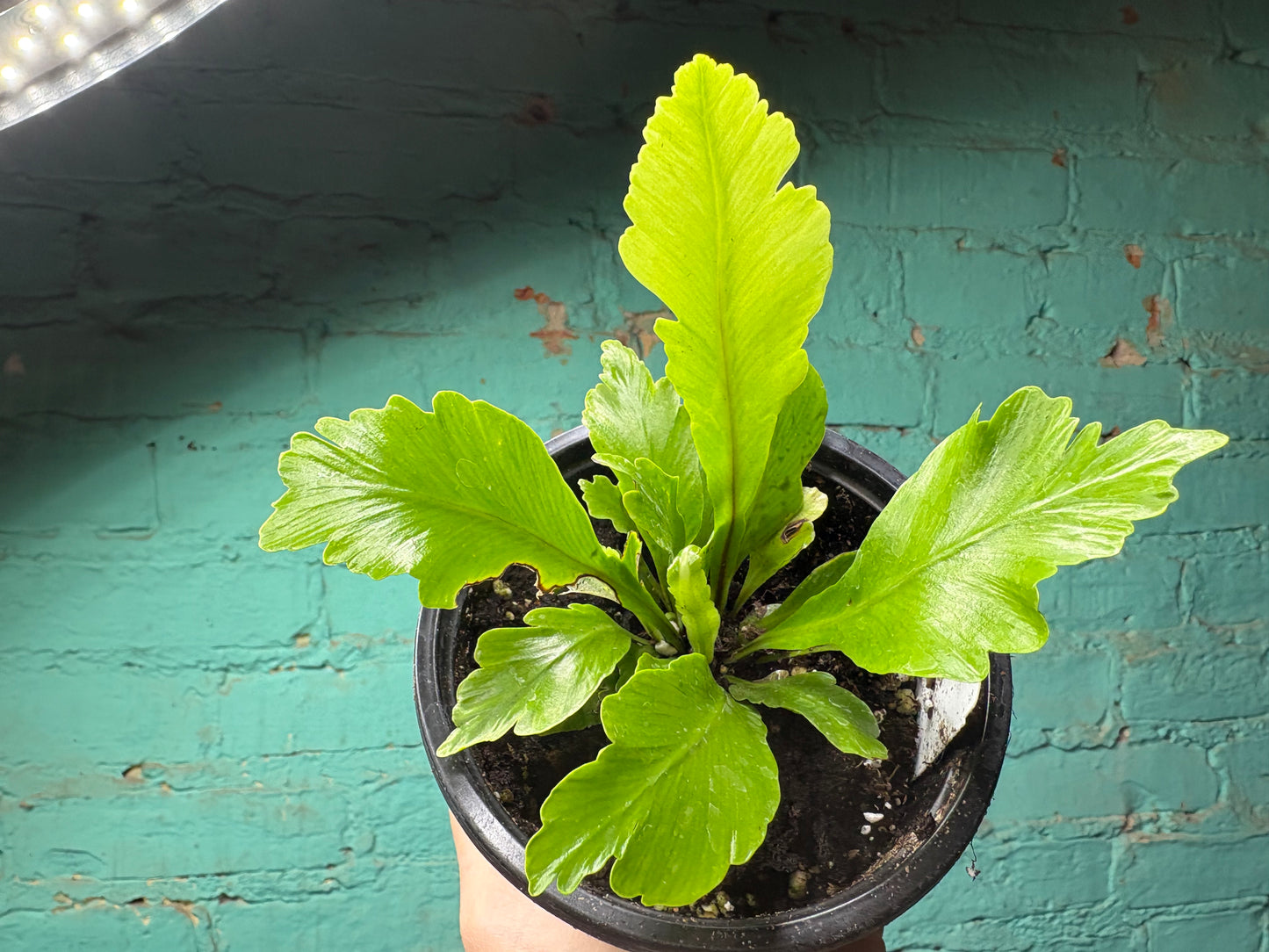
Each plant is unique. Size, shape, fullness, and variegation will vary.
Asplenium ‘Antiquum Champion’ | Champion Bird’s Nest Fern
The thick, glossy green fronds and beautifully rippled edges give this Bird’s Nest Fern a completely different look from traditional ferns. Champion is a cultivated selection of Asplenium antiquum, a species native to parts of East Asia where it grows in humid forests, often perched on trees and collecting moisture and organic material around its roots. That natural growth habit helps explain its unusual shape. Rather than producing delicate, divided fern foliage, Champion develops broad, leathery fronds with a prominent central vein and gently wavy margins, all emerging from a tightly arranged central rosette.
Champion grows in a circular, upright-to-arching form, with each new frond emerging from the center and gradually expanding outward. As it matures, the plant develops a fuller, layered appearance, with the rippled edges creating movement throughout the foliage. Established plants can develop a substantial spread, often reaching approximately 12–24 inches across indoors depending on growing conditions and container size. Its naturally symmetrical growth makes it especially appealing for tabletops, plant stands and shelves where the entire rosette can be appreciated.
For natural light, place it approximately 1–3 feet from an east-facing window or 2–4 feet from a north-facing window. Aim for approximately 300–700 foot-candles at the fronds as a practical home-growing range. Foot-candles simply tell you how much light is actually reaching your plant. Champion grows well with moderate usable light that supports steady production of sturdy new fronds. Watch the newest growth emerging from the center, along with the overall color and shape of the foliage, as you evaluate its placement. Strong direct sunlight can cause pale or dry patches on the exposed fronds.
Under a grow light, use a full-spectrum 5000–6500K fixture positioned approximately 12–18 inches above the canopy, adjusting the distance to maintain around 300–700 foot-candles at the fronds. Kelvin describes the color of the light, while foot-candles tell you how much light is actually reaching the plant. Position the fixture so the central growing point and surrounding fronds receive reasonably even illumination as the rosette expands.
Water when your plant needs watered. Champion appreciates a root zone that retains some moisture while still allowing plenty of airflow. A loose combination of moisture-retentive potting mix, fine orchid bark and perlite works well. Allow the plant to use some of the available moisture before watering thoroughly again, checking through the pot rather than relying on a set schedule. Because the newest fronds emerge from a central crown, direct water toward the substrate rather than repeatedly allowing water to collect in the center of the rosette. Comfortable household humidity can support growth, while good airflow helps the foliage and crown dry normally.
The center of the plant is where you’ll see its development most clearly. New fronds emerge tightly rolled or folded and gradually open into broad, glossy leaves with increasingly noticeable rippled margins. Older outside fronds may naturally age as the plant produces new growth. If new fronds repeatedly emerge smaller, distorted or fail to develop normally, evaluate usable light, moisture consistency, root health and the condition of the central crown. Healthy roots and a firm growing point are important indicators of how well the plant is establishing.
Success looks like a full, symmetrical rosette with sturdy green fronds, pronounced rippling along the margins and a steady succession of new growth emerging from the center. As Champion matures, the overlapping leaves create a sculptural, almost architectural appearance while maintaining the lush green character of a Bird’s Nest Fern. Its combination of substantial foliage, naturally organized growth and beautifully textured edges makes it a particularly interesting fern for an indoor collection.