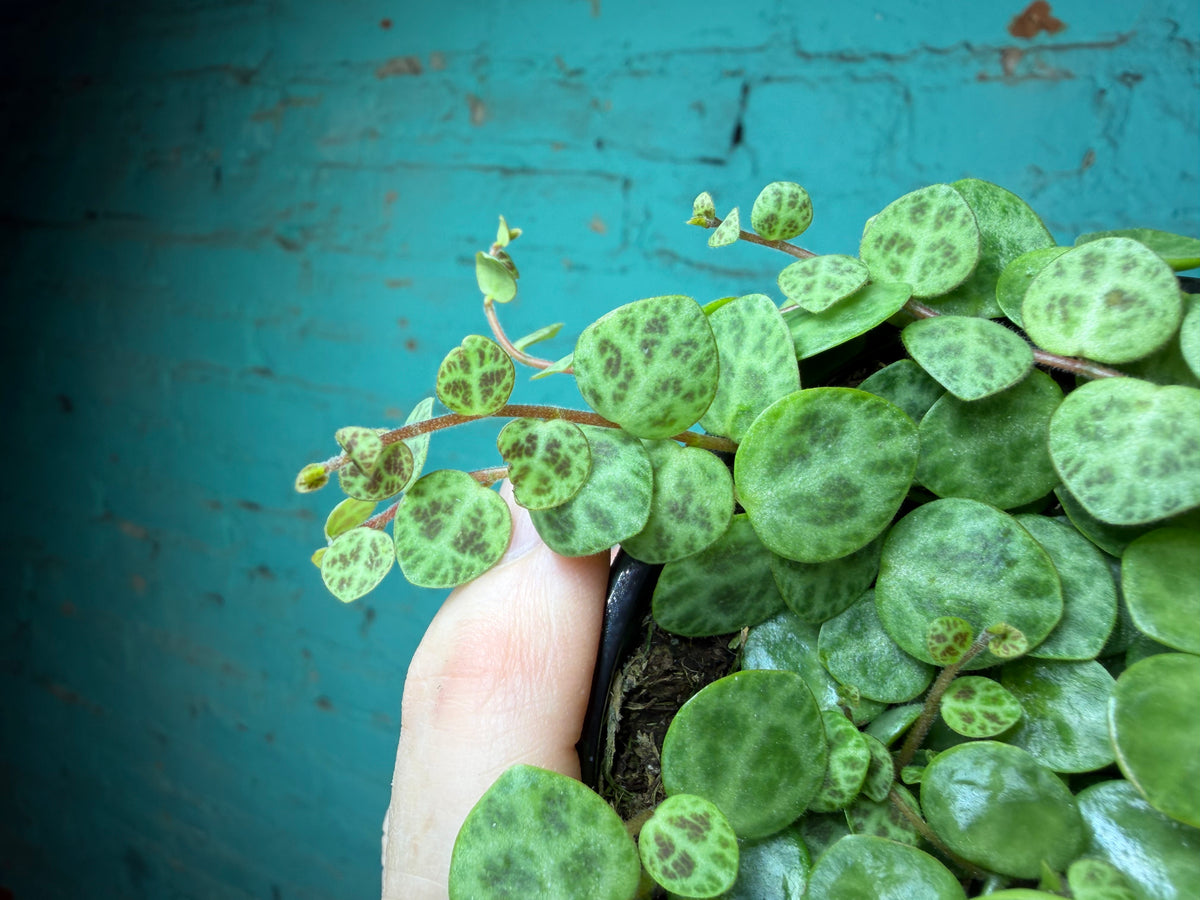
Each plant is unique. Size, shape, fullness, and variegation will vary.
String of Turtles - Succulent Form
String of Turtles Succulent is a trailing plant sold in the trade under the same common name as Peperomia prostrata, but the two plants look and grow quite differently. This is the thicker, more succulent form, with fleshy rounded leaves packed closely along trailing stems. The leaves have the turtle-shell appearance that gives the plant its common name, but compared with the Peperomia form, the foliage is noticeably thicker and the entire plant has a heavier, more succulent growth habit. A reliable botanical identity for this form is not consistently documented, so rather than attach an uncertain botanical name to it, Rooted distinguishes the two plants by their growth and care.
This form grows as a trailing vine, with stems that lengthen and eventually cascade over the sides of the container. It does not need a pole or vertical support. The fleshy leaves and stems store water, and that is an important difference between this plant and the more delicate Peperomia prostrata String of Turtles. As the plant matures, healthy stems should continue branching and creating a fuller cascade rather than producing increasingly thin, widely spaced growth.
For natural light, treat this String of Turtles more like a trailing succulent such as String of Hearts. Start it directly in an east-facing window or approximately 1–2 feet from a south-facing window. Aim for approximately 1,000–2,000 foot-candles at the leaves as a practical indoor starting range. Foot-candles simply tell you how much light is actually reaching your plant. Enough useful light helps maintain compact growth and closely spaced leaves. Window direction and distance are starting points. Trees, overhangs, neighboring buildings, window size, season, screens and glass can all change how much light actually reaches the plant.
If you’re using grow lights, choose a 5000–6500K light and aim for the same approximately 1,000–2,000 foot-candles at the foliage. Kelvin tells you the color of the light, not its strength. Foot-candles tell you how much light is actually reaching the plant. There is no universal distance between the plant and a grow light because every fixture produces a different amount of light. With a trailing plant, remember that the vines hanging below the container may eventually receive considerably less light than the growth directly underneath the fixture.
Water when your plant needs watered. The thick leaves give this form the ability to store water, so allow a substantial dryback before thoroughly watering again. Use an airy, fast-draining mix and a container that allows excess water to leave freely. Avoid keeping the root zone continuously wet simply because another plant sold as String of Turtles may prefer a different moisture cycle. These are two different plants, and that difference matters when you’re deciding how to care for them.
The foliage is one of your best tools for learning its watering rhythm. Well-hydrated leaves should feel thick and substantial. As the plant uses its stored moisture, the leaves may begin feeling less firm, which is a reason to check the root zone rather than automatically watering. If the plant is soft or declining while the pot remains wet, investigate how long the root zone is holding moisture. Increasingly long spaces between leaves, thin stems or stretched new growth are reasons to check whether enough useful light is reaching the plant.
Success looks like firm, fleshy leaves, sturdy trailing stems, active branching and relatively tight spacing between the leaves. Over time, healthy vines should continue extending over the sides of the container while maintaining substantial new growth. Don’t judge the plant by one older leaf or stem. Watch what the newest growth is doing. Dense, sturdy new growth is a much better indication that the environment is working.