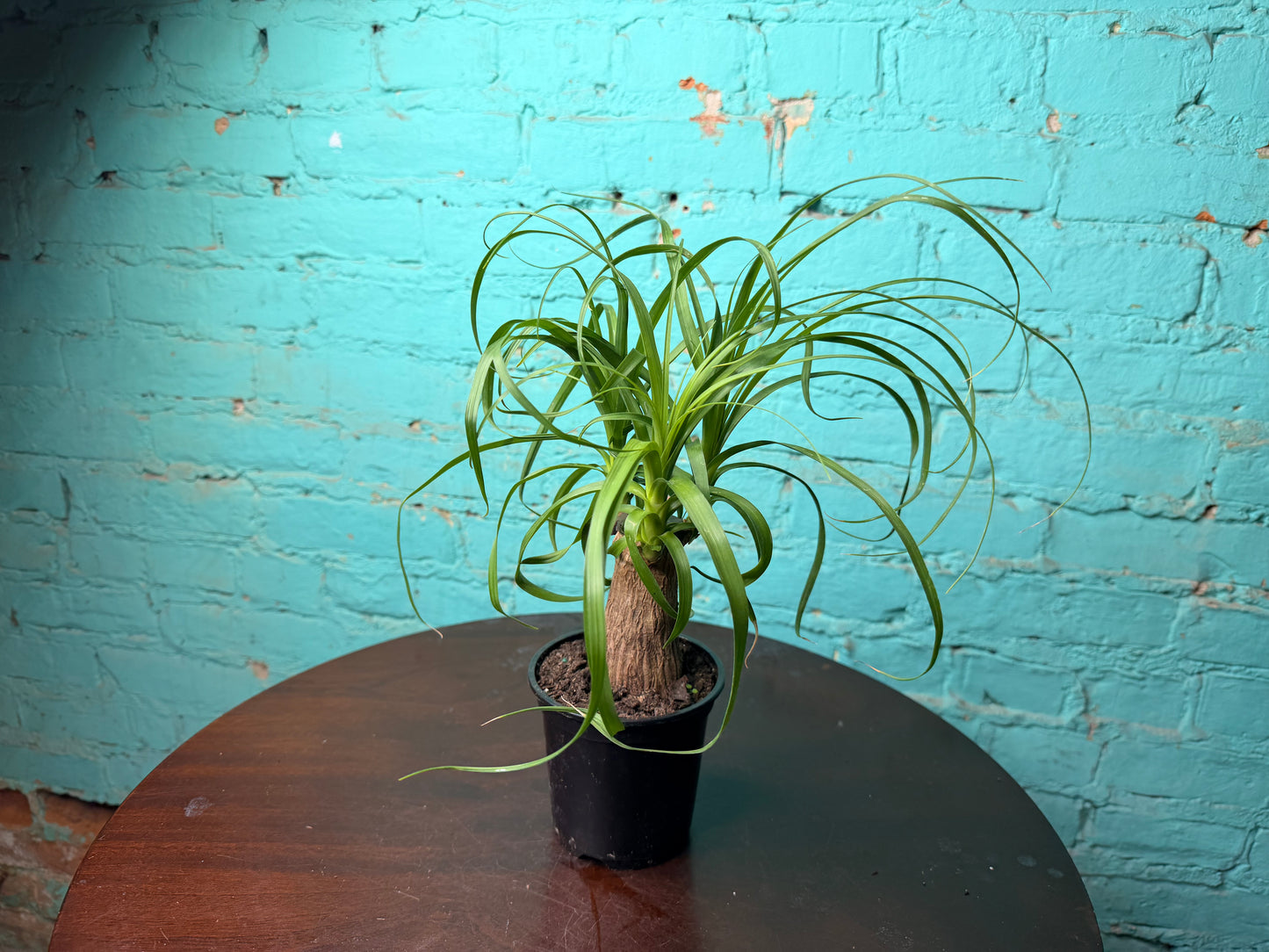
Ponytail Palm |Beaucarnea recurvata
Native to Mexico, this distinctive plant is not actually a palm. It is a drought-adapted tree that develops a swollen base called a caudex, which stores water and gives older plants their characteristic bottle-shaped trunk. Long, narrow leaves emerge from the top and curve downward in a fountain of green foliage. The combination of the enlarged trunk and cascading leaves becomes increasingly dramatic as the plant matures.
Growth is slow indoors, but this is not naturally a small plant. The caudex gradually becomes wider and the trunk taller and more woody with age, while established plants can develop additional branches and crowns of foliage. Indoors, mature specimens can eventually reach approximately 6–8 feet tall, although reaching that size takes time. It does not climb and needs no support.
For natural light, place it directly in a south-facing window or within approximately 1–2 feet of a west-facing window. Aim for approximately 2,000–4,000 foot-candles at the foliage. Foot-candles simply tell you how much light is actually reaching your plant. This is a high-light plant adapted to dry, exposed environments, and useful light helps maintain sturdy growth and a dense crown of foliage. Too little light can produce slower growth and increasingly weak, stretched foliage.
Under grow lights, use a 5000–6500K full-spectrum grow light approximately 8–12 inches above the top of the foliage as a starting point, aiming for approximately 2,000–4,000 foot-candles at the leaves. Kelvin tells you the color of the light, while foot-candles tell you how much light is actually reaching the plant. As the trunk becomes taller, move the fixture with the crown so the newest foliage continues receiving strong useful light.
Water when your plant needs watered. The swollen base is built to store water, so allow the root zone to dry substantially before watering thoroughly again. Constant moisture around the roots and caudex works against the way this plant is built to grow. A coarse, fast-draining mix and a container with excellent drainage allow the roots to receive a full watering without remaining wet for long periods. Keeping the pot reasonably matched to the root system also helps the growing medium dry appropriately.
Read both the root zone and the newest growth. A pot that remains wet for a long time is a reason to look at light, pot size and the growing mix before adding more water. Weak or increasingly stretched new foliage can point toward insufficient light. Brown leaf tips can develop for several reasons and are better treated as a clue to look at the plant’s overall environment rather than as a diagnosis by themselves.
Success looks like a firm, gradually enlarging caudex topped with a dense crown of long, arching leaves. New foliage should emerge from the center of the crown and develop into strong, substantial leaves rather than increasingly weak growth. Over time, the expanding base, developing trunk and fuller crown transform a young plant into the sculptural tree-like form that makes it so distinctive.