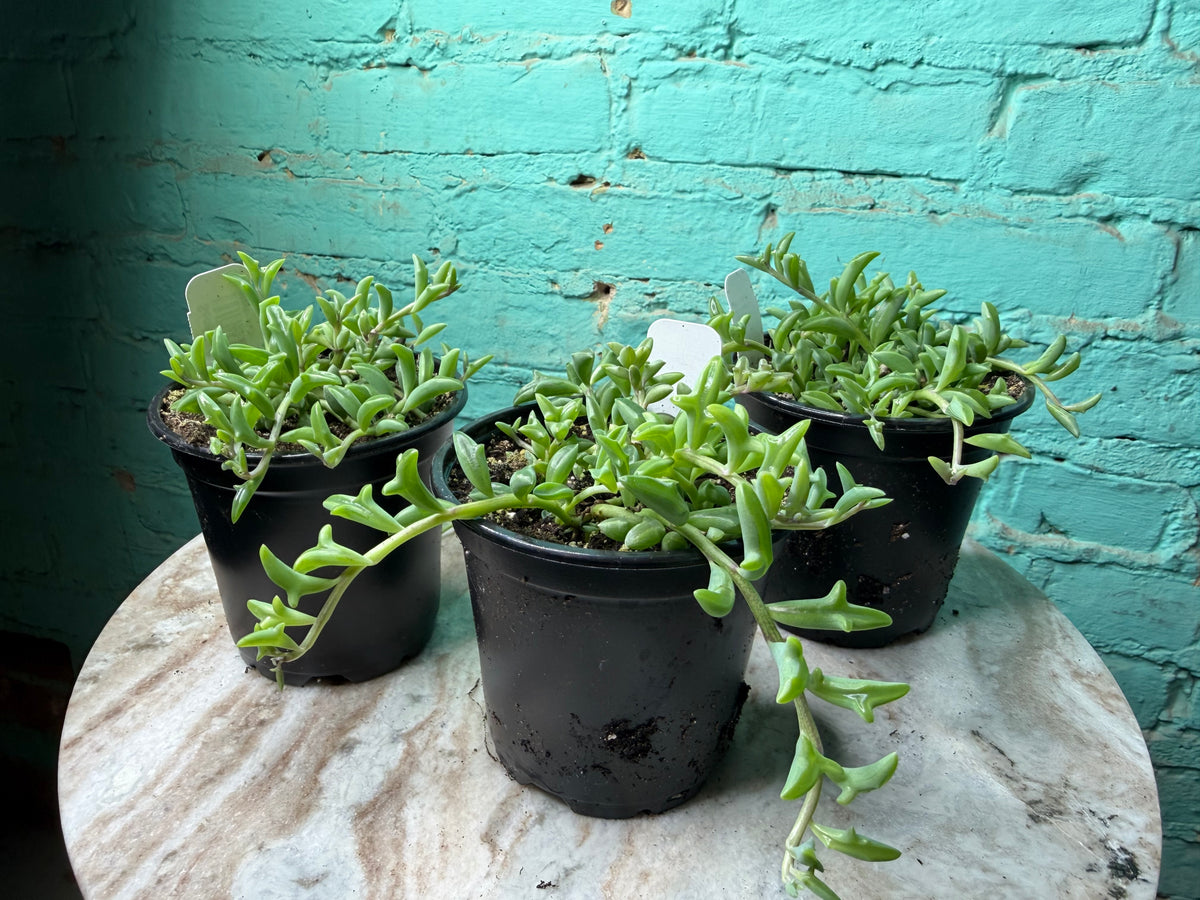
Each plant is unique. Size, shape, fullness, and variegation will vary.
String of Dolphins is a trailing Curio grown for one of the strangest leaf shapes in the group: each fleshy leaf develops little projections that make it look remarkably like a dolphin jumping from the stem. You’ll see the botanical name written as Curio peregrinus and also Curio × peregrinus in cultivation. The naming and often-repeated hybrid history aren’t documented consistently enough for me to present a specific parentage as fact, but the plant itself is unmistakable. Its sculpted succulent foliage is the reason people grow it.
String of Dolphins develops long stems that eventually cascade from the container. It does not need a pole or vertical support. The plant stores water in its fleshy foliage, while healthy stems continue branching and lengthening to create a fuller trailing plant. The characteristic dolphin shape can also become less pronounced when the plant isn’t receiving enough useful light, so its new growth gives you a surprisingly good way to evaluate the environment.
For natural light, start String of Dolphins directly in an east-facing window or approximately 1–2 feet from a south-facing window. String of Dolphins prefers approximately 1,500–3,000 foot-candles at the leaves indoors. Foot-candles simply tell you how much light is actually reaching your plant. Enough useful light helps maintain sturdy stems, closer spacing and the characteristic shape of the foliage. Window direction and distance are starting points. Trees, overhangs, neighboring buildings, window size, season, screens and glass can all change how much light actually reaches the plant.
If you’re using grow lights, choose a 5000–6500K light and aim for approximately 1,500–3,000 foot-candles at the foliage. Kelvin tells you the color of the light, not its strength. Foot-candles tell you how much light is actually reaching the plant. There isn’t one correct number of inches between this plant and a grow light because different fixtures produce very different amounts of usable light. Measure where the plant is actually growing, and remember that long trailing stems can eventually hang well below the strongest area of the fixture.
Water when your plant needs watered. String of Dolphins stores water in its thick leaves, so allow a substantial dryback before thoroughly watering again. Use a coarse, well-draining succulent mix and a container that allows excess water to drain freely. Avoid keeping the root zone continuously damp. How quickly it uses water will also change with light, temperature, root development and the amount of foliage the plant is supporting.
Healthy dolphin leaves should feel plump and substantial. As the plant uses its stored moisture, they can become less firm, which is a reason to check the root zone before deciding whether it’s time to water. Pay attention to the newest leaves as well. Longer spaces between leaves, increasingly thin stems or new foliage losing its characteristic compact dolphin shape are reasons to investigate whether enough useful light is reaching the plant.
Success looks like sturdy trailing stems, plump foliage, active branching and new leaves that continue developing that recognizable dolphin shape. As the plant matures, the stems should gradually cascade farther over the container while continuing to produce substantial new growth. Don’t judge the plant by one odd leaf. Watch the direction of the newest growth. That’s where String of Dolphins will tell you whether the environment you’re providing is working.