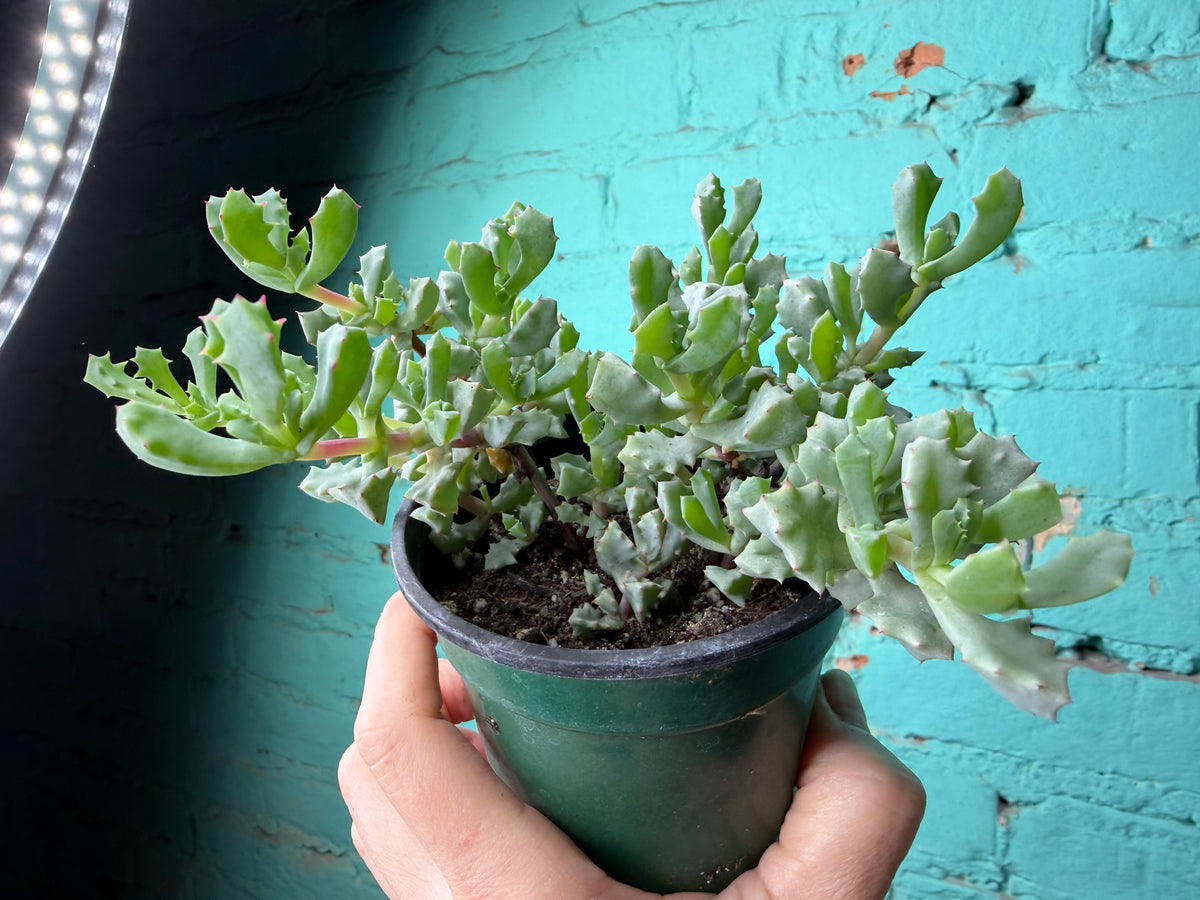
Each plant is unique. Size, shape, fullness, and variegation will vary.
Pink Ice Plant, Oscularia deltoides, is a succulent native to the Western Cape of South Africa, where it naturally grows among exposed sandstone rocks. Its foliage is what makes it immediately recognizable. The blue-gray to green leaves are thick, triangular and edged with tiny teeth, while the stems can develop beautiful reddish to purple coloring. As the plant matures, it can also produce masses of small pink flowers. Even without flowers, the unusual leaf shape and contrast between the cool-toned foliage and colorful stems make this a really interesting succulent.
Pink Ice Plant is naturally a low, spreading plant rather than an upright succulent. Its stems branch, spread outward and eventually trail, making it especially well suited to the edge of a pot or hanging container. In its natural habitat it behaves more like a succulent groundcover, so don’t expect it to hold a tight upright shape as it matures. The longer, branching growth spilling from the pot is part of what this plant naturally wants to do.
For natural light, start Pink Ice Plant directly in a south-facing window or within approximately 1 foot of a west-facing window. Pink Ice Plant prefers approximately 2,000–4,000 foot-candles at the leaves when grown indoors. Foot-candles simply tell you how much light is actually reaching your plant. This is a much higher-light plant than many of the tropical plants we grow indoors. Strong useful light helps maintain compact growth, sturdy stems and the characteristic coloring rather than allowing the plant to become stretched and weak. Window direction and distance are still starting points. Trees, overhangs, neighboring buildings, window size, season, screens and glass can dramatically change how much light actually reaches the plant.
If you are using grow lights, choose a 5000–6500K light and aim for the same approximately 2,000–4,000 foot-candles at the foliage. Kelvin tells you the color of the light, not how strong it is. Foot-candles tell you how much light is actually reaching the plant. There is no universal distance between the grow light and Pink Ice Plant because fixtures produce very different amounts of light. This is one where a small or low-output grow light may simply not provide enough intensity or coverage, so measure at the foliage rather than assuming the plant is receiving enough light because a grow light is above it.
Water when your plant needs watered. Pink Ice Plant stores water in its thick leaves and stems and naturally grows in rocky, fast-draining conditions, so it should be allowed a substantial dryback between thorough waterings. Use a coarse, well-draining succulent mix and a container that allows excess water to leave freely. This plant is much more comfortable becoming dry than remaining in a dense, wet root zone for extended periods. Its water use will also change dramatically with light. A Pink Ice Plant receiving several thousand foot-candles will move through water very differently from one struggling in a darker window.
Read the shape and firmness of the plant. Healthy leaves should feel fleshy and substantial. As stored water is used, the foliage may begin to feel less firm, which is a reason to check the root zone rather than automatically reaching for the watering can. Soft or declining growth while the pot is still wet should make you investigate how long the root zone has remained wet. Light gives you another very useful cue with this plant. Increasingly long spaces between leaves, thinner stems and stretched growth are reasons to check whether it is receiving enough light. Some reddish coloring along the stems and foliage can be completely normal, particularly under stronger light.
Success looks like dense branching, sturdy growth, closely spaced fleshy leaves and stems that gradually spread and trail around the container. With enough useful light and maturity, the plant may also reward you with its pink flowers. This is a plant where the overall shape tells you a lot. Compact, substantial new growth is a much better indication that the environment is working than expecting every older leaf or stem to remain perfect.