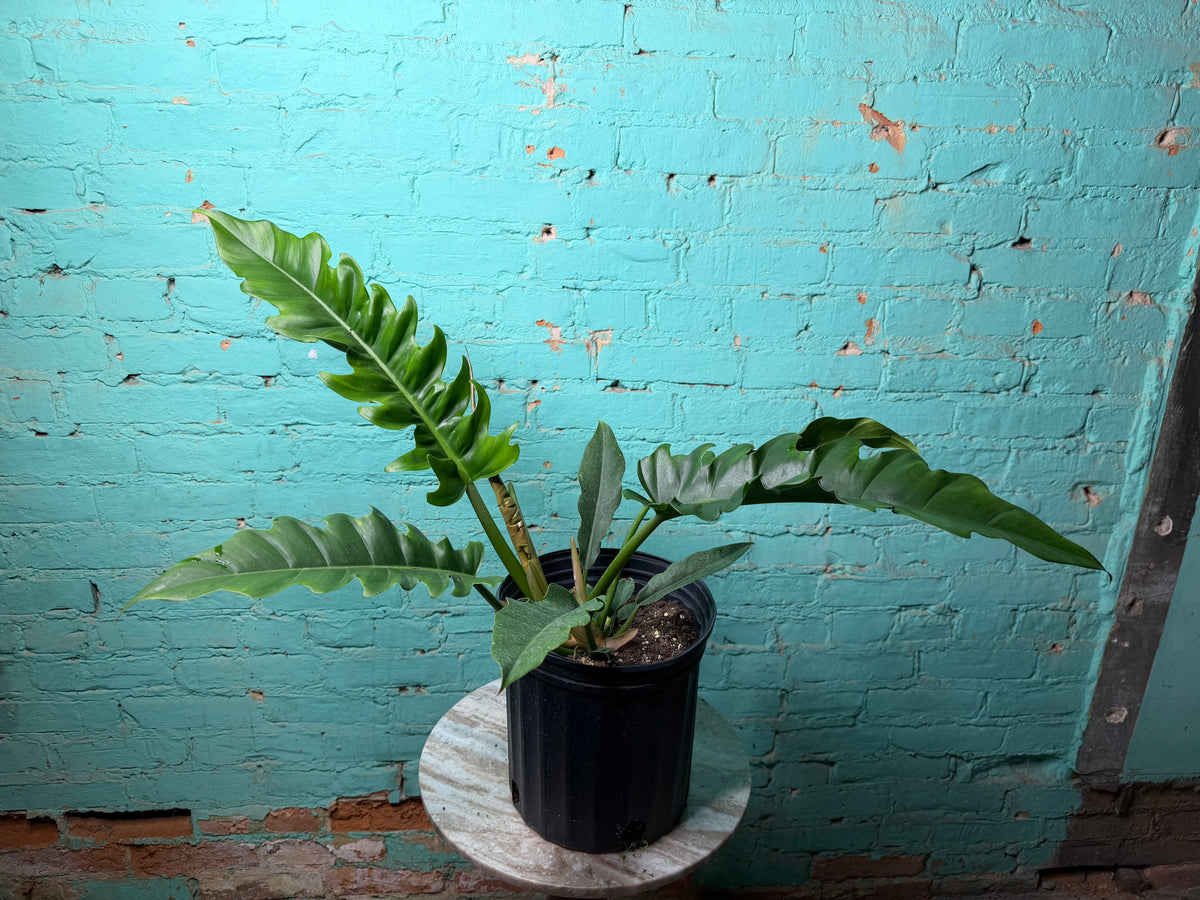
Each plant is unique. Size, shape, fullness, and variegation will vary.
Philodendron ‘Narrow’ is grown for its long green leaves with deeply cut, tooth-like margins that become increasingly dramatic as the plant matures. You may find this plant sold as Narrow, Narrow Escape, Jungle Boogie, Tiger Tooth or Henderson’s Pride, with these names used inconsistently and often interchangeably throughout the plant trade. Its exact horticultural history is less settled than the trade names suggest, so rather than assigning an uncertain species or parentage, it is best treated as a cultivated Philodendron selected for its distinctive narrow, serrated foliage.
Young plants can remain fairly compact, with leaves developing closely around a short central stem. As the plant matures, the leaves become considerably longer and the deeply cut margins become more pronounced. Mature leaves can approach several feet in length under favorable conditions. The stem can also become more apparent with age, and aerial roots may develop along it. A vertical support can help stabilize a larger plant and encourage a more upright growth habit as it gains size.
For natural light indoors, place it directly in an east-facing window or approximately 1–2 feet from a south-facing window. It prefers approximately 800–1,500 foot-candles at the leaves. Foot-candles simply tell you how much light is actually reaching your plant. Enough usable light supports larger leaves, tighter spacing between leaves and stronger growth. If the spaces between new leaves begin increasing, the plant starts leaning strongly toward the window or successive leaves become smaller, check the amount of light reaching the foliage and move it closer if needed.
Under a grow light, use a full-spectrum 5000–6500K fixture positioned approximately 8–12 inches above the canopy, aiming for the same 800–1,500 foot-candles at the leaves. Kelvin describes the color of the light, while foot-candles tell you how much light is actually reaching the plant. Keep the fixture positioned above the newest growth and raise it as the plant becomes taller so the developing leaves continue receiving useful light.
Water when your plant needs watered. Allow the root zone to use a good portion of its available moisture before watering thoroughly again rather than keeping the soil continuously wet. Its roots do well in an airy mix that holds some moisture while allowing excess water to drain and oxygen to move back through the root zone. A mix containing potting material along with chunky bark and perlite or pumice can provide that balance. How quickly the plant uses water will change with light, temperature, root mass, pot size and active growth, so check the root zone rather than watering according to a calendar.
Watch the newest growth for changes in the plant’s environment. Increasingly long spaces between leaves, smaller new foliage or growth reaching strongly toward the light can indicate that it needs more usable light. If the root zone begins remaining wet considerably longer than it normally does, look at changes in light, temperature, root mass and pot size before adding more water. New leaves emerge softer and less developed than hardened foliage, so allow them to fully expand and mature before judging their final size and shape.
Success looks like steady new growth, strong roots, increasingly substantial leaves and deeper, more pronounced tooth-like divisions along the margins as the plant matures. Older leaves will not always have the same dramatic shape as newer mature foliage. Watch the progression of several leaves over time. Increasing leaf size, compact spacing between growth points and continued root and stem development are the best signs that the plant’s environment is supporting its mature form.