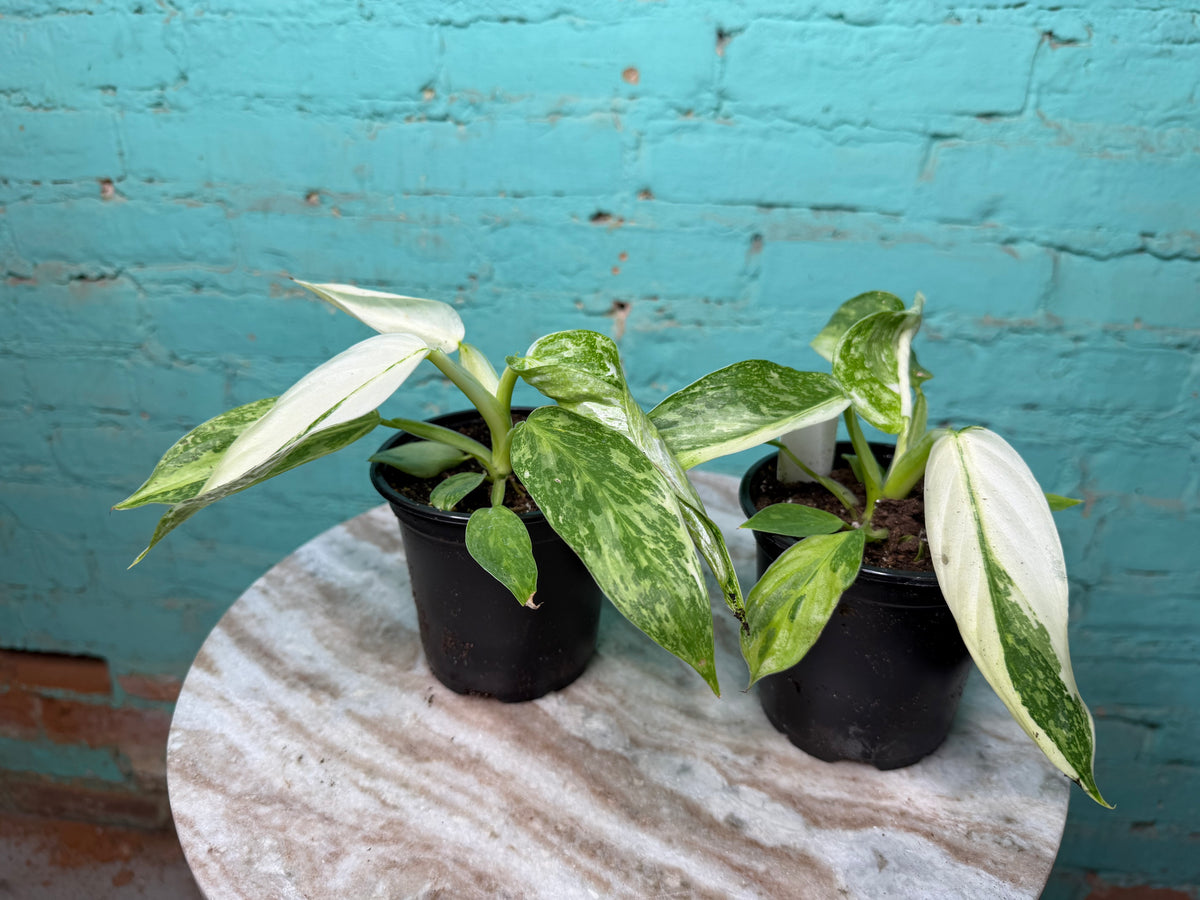
Each plant is unique. Size, shape, fullness, and variegation will vary.
Large, elongated leaves splashed and marbled with cream to white variegation make this a Philodendron that becomes dramatically more impressive as it matures. Each leaf can develop its own balance of green and pale tissue, from fine mottling to broad sectors, so the plant continually changes as it grows. ‘Jose Buono’ is a cultivated climbing Philodendron rather than a botanical species, and its exact parentage is not reliably documented. Plants sold as Jose Buono Albo emphasize the paler white-to-cream variegation, but the Albo designation should be treated as a trade description rather than a separately documented botanical cultivar.
This is a true climber with a central stem, distinct nodes and aerial roots. Juvenile leaves can be relatively modest, but with maturity and a vertical support they become substantially larger, broader and more elongated. Give the aerial roots something they can attach to, such as a moss pole or other climbable support, rather than allowing a mature plant to continually trail. Support does more than hold the plant upright. It helps the plant continue its climbing growth pattern and can encourage progressively larger foliage and shorter, stronger spacing between leaves.
For natural light indoors, place it directly in an east-facing window or approximately 1–2 feet from a south-facing window. Aim for approximately 1,000–2,000 foot-candles at the leaves. Foot-candles simply tell you how much light is actually reaching your plant. The green portions of each leaf contain the chlorophyll doing most of the photosynthetic work, so a highly variegated plant has less productive green tissue available than an all-green plant. Stronger light does not create white variegation, but adequate usable light helps the green tissue support the entire leaf. Increasingly long internodes, smaller successive leaves or strong reaching toward the window are useful signals that the plant may need more light.
Under a grow light, use a full-spectrum 5000–6500K fixture positioned approximately 8–12 inches above the canopy, aiming for 1,000–2,000 foot-candles at the leaves. Kelvin describes the color of the light, while foot-candles tell you how much light is actually reaching the plant. As the plant climbs, move the fixture with the active growing point and make sure the newest foliage remains within the useful coverage of the light. Large mature leaves can quickly outgrow a small fixture even when the distance from the top leaf looks correct.
Water when your plant needs watered. Allow a good portion of the available moisture to be used before watering thoroughly again rather than keeping the root zone continuously wet or repeatedly allowing it to become severely dry. Use a loose aroid substrate containing chunky bark, perlite or pumice and enough moisture-retentive material to prevent the roots from drying immediately after watering. A climbing plant attached to a support can increase its water use considerably as its leaf size and root system expand, so learn how quickly your individual plant is using water rather than keeping it on the same schedule as it matures.
Watch both the newest growth and the spacing along the stem. Progressively larger leaves and relatively compact internodes tell you the plant has enough resources to continue maturing. Increasingly smaller leaves or longer spaces between nodes can point toward insufficient usable light, lack of effective support or a root system that is no longer keeping up with the canopy. Highly variegated portions can also brown more readily because they contain little or no chlorophyll. One damaged white section does not automatically mean the entire plant is unhealthy. Look at what the newest leaves, roots and stem are doing together before making a major change.
Success looks like strong attachment to its support, active aerial roots, a sturdy climbing stem and leaves that become increasingly substantial as the plant gains height. Variegation will naturally vary from leaf to leaf, so success is not producing the maximum amount of white. A healthy balance of green tissue, strong roots and progressively mature foliage gives the plant the resources to continue producing the large, beautifully variegated leaves that make Jose Buono so impressive.