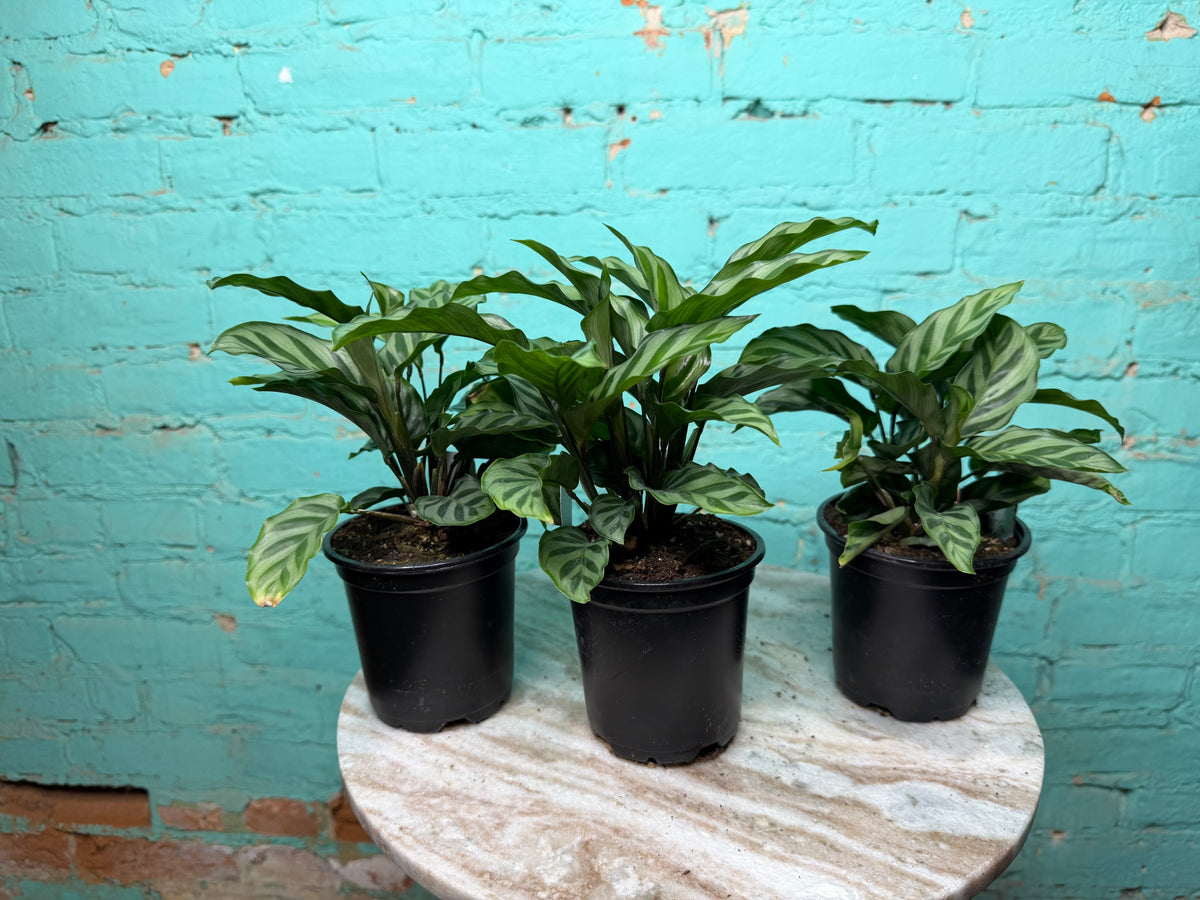
Each plant is unique. Size, shape, fullness, and variegation will vary.
Long, softly pointed leaves covered in alternating bands of light and deep green give this prayer plant an almost painted appearance. The darker markings sweep outward from the center vein in a repeating pattern, while the slightly rippled leaves create even more movement as the plant fills out. Commonly sold as Calathea Freddie, it belongs to Goeppertia concinna, a species native to southeastern Brazil where it grows as a perennial in wet tropical environments. ‘Freddie’ is the horticultural name associated with this distinctive striped form.
This is a compact, clumping plant rather than a vine or cane. New leaves emerge rolled tightly from the base and gradually unfurl as the underground rhizome produces additional growing points. Over time, those individual growth points create a wider, fuller plant with foliage held at different heights. Like other prayer plants, the leaves can reposition themselves throughout the day and rise more noticeably at night. That movement is normal and should not be confused with the persistent curling or folding a stressed leaf may show.
For natural light indoors, place it 1–3 feet from a north-facing window or 2–4 feet from an east-facing window. Aim for approximately 300–700 foot-candles at the leaves. Foot-candles simply tell you how much light is actually reaching your plant. This is an understory plant and does not need the intensity we would give a Ficus or many aroids. If newer leaves become progressively smaller, growth slows considerably or the plant begins leaning strongly toward its light source, it may need to move closer. Pale or bleached areas developing on the most exposed foliage can indicate that the light has become too intense.
Under a grow light, use a full-spectrum 5000–6500K fixture positioned approximately 12–18 inches above the canopy, aiming for 300–700 foot-candles at the leaves. Kelvin describes the color of the light, while foot-candles tell you how much light is actually reaching the plant. Because this plant grows outward from multiple points rather than continually upward from one stem, even coverage across the entire pot is more useful than concentrating intense light over one section of the foliage.
Water when your plant needs watered. Unlike plants that store large reserves of water, this prayer plant does best when the root zone retains some moisture between waterings rather than repeatedly becoming completely dry. Use a loose, moisture-retentive substrate that still allows air around the roots, such as a quality potting mix amended with fine bark and perlite or pumice. Water quality can also show up in the foliage over time. If your water contains a high concentration of dissolved minerals or salts, repeated watering can contribute to browned tips and margins, so filtered, distilled or rainwater can be useful when water quality is an ongoing issue.
Watch the newest leaves and the way the entire plant is holding itself. Normal nighttime movement is temporary, with leaves changing position again as the light cycle changes. Leaves that remain tightly curled during the day are telling you something different. Check the moisture deeper in the pot, how quickly the plant has been drying, the roots, temperature and the amount of usable light before assuming humidity is the answer. Crispy margins can have several causes, including repeated dryback, root stress and water quality, while yellowing accompanied by a pot that stays wet for a long time is a reason to investigate the root zone.
Success looks like new leaves regularly unfurling from the base, strong green patterning and a clump that gradually becomes wider and denser. Individual older leaves will eventually decline as the plant replaces them, so judge its direction by the newest growth rather than expecting every leaf to remain perfect forever. When new leaves are reaching a healthy size, opening cleanly and additional growth points are filling the pot, the plant is moving in the right direction.