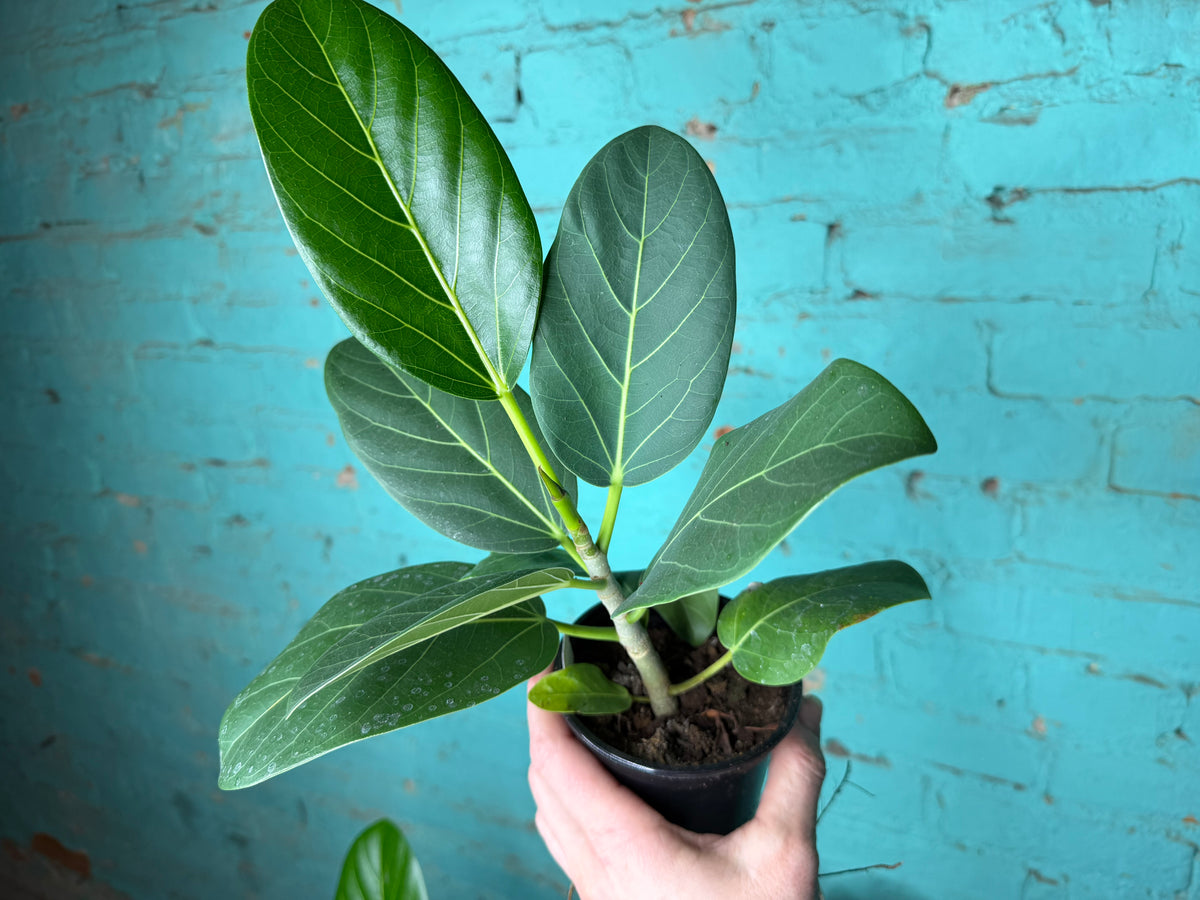
Each plant is unique. Size, shape, fullness, and variegation will vary.
Ficus benghalensis ‘Audrey’ | Ficus Audrey
Soft, velvety green leaves with pale contrasting veins give this Ficus a noticeably different look from the glossy foliage of many other indoor Ficus. The leaves are broad and substantial without becoming as heavily rippled as a Fiddle Leaf Fig, and new growth emerges from protective stipules at the ends of the branches. This cultivated form belongs to Ficus benghalensis, the Indian banyan, a tree native to the Indian subcontinent that can become enormous outdoors. Indoors, ‘Audrey’ gives you the structure and presence of a tree in a much more manageable container-grown form.
This is a woody tree rather than a vining plant. Young plants often begin with a single upright trunk, but pruning the active growing tip can encourage branching and create a fuller canopy. As it matures, the trunk becomes thicker and woodier while new branches carry progressively more foliage. The species is famous for producing aerial roots in its natural environment that can eventually reach the ground and become supporting structures, although that dramatic banyan growth is far less likely indoors. Container-grown plants can still reach approximately 6–10 feet with enough time, light and room to develop.
For natural light indoors, place it directly in an east-facing window or approximately 1–2 feet from a south-facing window. Aim for approximately 1,500–3,000 foot-candles at the leaves. Foot-candles simply tell you how much light is actually reaching your plant. This is a tree capable of growing in very strong tropical light, so placing it deep inside a room simply because it is being grown as a houseplant can leave it without enough energy to maintain dense growth. If the spaces between new leaves increase, new foliage becomes progressively smaller or the canopy begins leaning heavily toward the window, increase the usable light. Rotate the plant periodically if you want more even growth around the canopy.
Under a grow light, use a full-spectrum 5000–6500K fixture positioned approximately 8–12 inches above the canopy, aiming for 1,500–3,000 foot-candles at the leaves. Kelvin describes the color of the light, while foot-candles tell you how much light is actually reaching the plant. Coverage matters as much as intensity once this becomes a larger tree. A small fixture directly over the top may support the newest growth while leaving the rest of a broad canopy poorly lit, so the lighting setup may need to grow along with the plant.
Water when your plant needs watered. Allow it to use a substantial portion of the available moisture before watering thoroughly again, but avoid repeatedly taking the entire root ball to an extreme dry. A larger tree with an established root system and full canopy can move through water surprisingly quickly when light is strong, while the same plant can remain wet much longer after a seasonal or environmental change. Use a loose mix that combines moisture-retentive potting material with coarse bark and perlite or pumice so water can move through the pot while oxygen remains available around the roots. Check deeper into the root zone rather than judging a large container by a dry surface alone.
Leaf drop is one of the most useful signals this plant can give you, but it is not a diagnosis by itself. Ficus can respond to abrupt changes in light, watering, temperature or location by dropping foliage, especially after being moved into a new environment. Before changing several things at once, look at what changed immediately before the leaf loss began. Older lower leaves declining occasionally is different from multiple healthy leaves dropping throughout the canopy. Also watch the newest growth. Smaller successive leaves, increasing distance between leaves and a canopy reaching strongly in one direction are useful reasons to investigate light before assuming the problem is watering.
Success looks like a sturdy developing trunk, active branch tips and substantial new leaves emerging at relatively close intervals. As the plant matures, the goal is not simply height. Strong branching and a progressively fuller canopy create the tree-like form that makes ‘Audrey’ so impressive indoors. Consistent new growth, increasing stem strength and foliage that remains firm and well supported tell you that the plant has the resources it needs to continue developing into a substantial indoor tree.