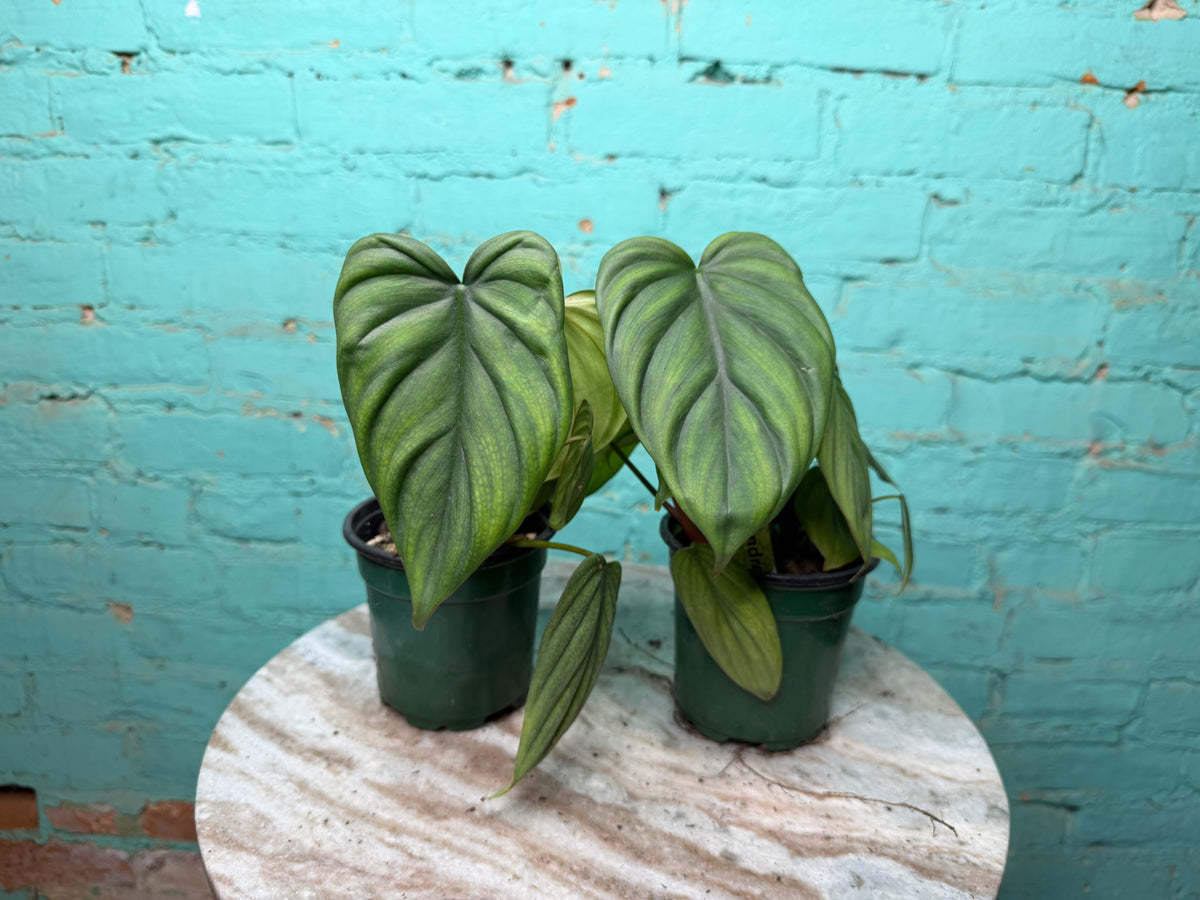
Each plant is unique. Size, shape, fullness, and variegation will vary.
Columbia Philodendron
Huge heart-shaped leaves with deeply impressed veins give this Philodendron an almost quilted appearance, with raised sections between the veins creating a dimensional, pillowy surface. As the leaves mature, the foliage can develop rich green to blue-green tones, and the way light moves across the textured surface can give portions of the leaf a subtle silvery cast. This collector plant circulates under the provisional name Philodendron sp. ‘Columbia’ or ‘Colombia’. A reliably established species identity has not been published for the plant in cultivation, so the geographic trade name is more appropriate than assigning it a species it may not actually be.
This is a terrestrial crawler, and that is one of the most important things to understand about growing it. Rather than sending a stem upward in search of a tree or moss pole, the thick stem travels horizontally across the surface of the growing medium and produces leaves as it advances. Young plants can fit comfortably in a standard nursery pot, but an established plant benefits from a wider or rectangular container that gives the crawling stem somewhere to go. Keep that stem at the surface rather than gradually burying it as the plant advances. A moss pole is unnecessary. Given room to crawl and a healthy root system, successive leaves can become dramatically larger and develop increasingly pronounced texture.
For natural light indoors, place it 1–3 feet from an east-facing window or 2–4 feet from a west-facing window. Aim for approximately 600–1,200 foot-candles at the leaves. Foot-candles simply tell you how much light is actually reaching your plant. This is not a plant that needs extremely intense light to produce beautiful foliage. What matters is enough usable light to support those increasingly large leaves without pushing the foliage into unnecessary light stress. If successive leaves become smaller, the growth begins reaching noticeably toward the window or the plant’s overall growth slows while the root system is healthy, increase the usable light.
Under a grow light, use a full-spectrum 5000–6500K fixture positioned approximately 10–14 inches above the canopy, aiming for 600–1,200 foot-candles at the leaves. Kelvin describes the color of the light, while foot-candles tell you how much light is actually reaching the plant. As the crawler advances, remember that the newest leaf may eventually be well outside the area where the original light was centered. Coverage across the length of the plant becomes increasingly important as the rhizome-like stem travels through a longer container.
Water when your plant needs watered. This crawler does not have the same water-storage strategy as a ZZ or succulent, so allow it to use a good portion of the available moisture without repeatedly taking the entire root zone severely dry. Give it a loose, coarse aroid substrate containing chunky bark and perlite or pumice with enough moisture-retentive material to keep water available between waterings. The goal is a root zone that can hold useful moisture while still containing plenty of air. When repotting, pay particular attention to the crawling stem. Position it on top of or immediately along the surface of the substrate, with the roots directed into the mix. Burying the advancing stem too deeply can keep the growth points unnecessarily wet and interfere with the way the plant naturally travels across the surface.
Watch the progression from one leaf to the next. A crawler with a healthy root system and enough usable light should be able to continue advancing while producing substantial foliage. Successively smaller leaves, stalled growth or a new leaf that struggles repeatedly can be a reason to look at the roots, moisture consistency and usable light. Also watch where the growing tip is headed. If it reaches the wall of a round pot and begins trying to climb over the edge, the plant is not asking for a moss pole. It is telling you that its horizontal stem has run out of room. That is the time to consider a longer container and reposition the crawler so it has space in front of the active growth point.
Success looks like a healthy crawling stem moving across the soil surface, active roots, relatively close growth points and increasingly substantial heart-shaped leaves. As the plant matures, the deep venation becomes more dramatic and the broad foliage develops the heavily textured appearance that makes this collector Philodendron so distinctive. With Columbia, the goal is not to make it climb. Give it room to crawl, and let each successive leaf show you what the plant is capable of becoming.